CROSS FLOW FAN:
the complete guide to types, specs & applications
Everything engineers and procurement teams need to know about cross flow fans (tangential fans) - from working principles and key specifications to application-specific selection.
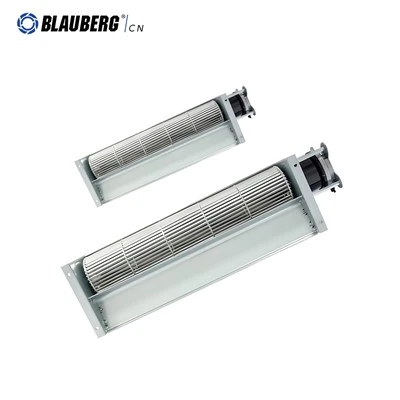
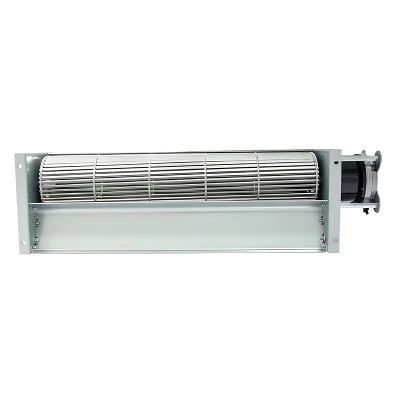
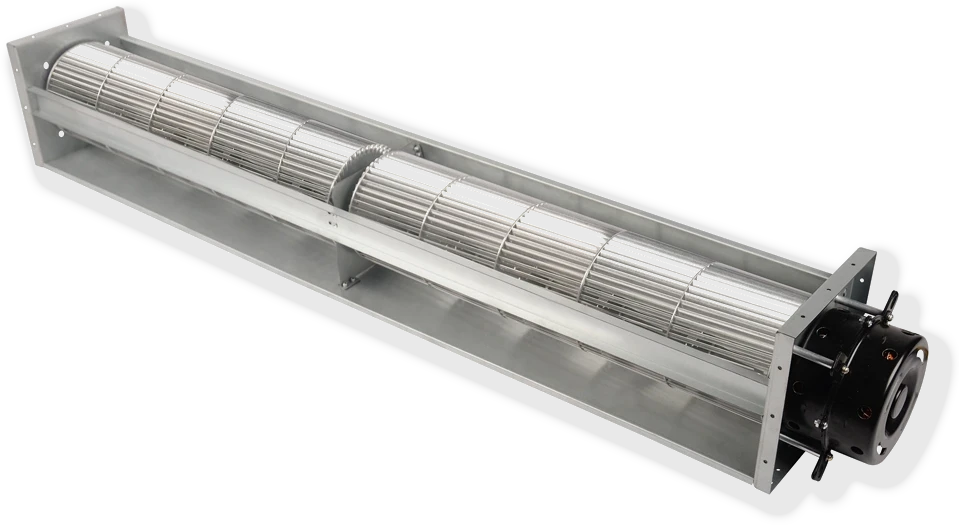
A cross flow fan — also referred to as a tangential fan, transverse fan, or cross flow blower — is a fan type characterized by its long, cylindrical impeller fitted with multiple forward-curved blades. Unlike axial fans (which move air parallel to the shaft) or centrifugal fans (which discharge air radially outward), the cross flow fan draws air in from one side of the impeller and expels it from the opposite side-all within the same plane and perpendicular to the rotation axis.
Viewed from the side, the impeller resembles an elongated hamster wheel or a manual lawn mower reel. This geometry enables the fan to generate a wide, flat,uniform stream of air across the entire length of its outlet - a characteristic no other fan type can replicate in a slim form factor.
In practical terms: If you need to push a consistent sheet of air across a long, narrow opening - like the vent of a split-type air conditioner, an air curtain doorway, or a flat-panel heater - the cross flow fan is uniquely suited to do the job quietly and efficiently.
AC Cross Flow Fan
Cost-stable AC tangential fans for mains-powered appliances, heating equipment, refrigeration, and high-volume OEM systems.
Standard 230V/50 Hz operation keeps electrical integration simple.Shaded-pole or PSC motor options support reliable fixed- speed operation. Speed can be adapted by reduced voltage or multiple winding taps.

DC Cross Flow Fan
Low-voltage cross flow fans for precise control, low noise, and compact HVAC or electronics cooling systems.
12V and 24V DC versions suit control-driven OEM equipment. Brushless DC motors use 3-phase drive technology for efficient, quiet operation. Speed can be controlled by 0-10V DC or PWM signals.

EC Cross Flow Fan
High-efficiency EC tangential blowers for variable-speed equipment that still requires direct AC mains input.
230V 50/60Hz input removes the need for a separate DC power supply.EC motors combine high effciency with precise speed control.Control can be handled through 0-10V DC or PWM signals.
SELECT BY MOTOR AND CONTROL METHOD,
NOT ONLY BY SHAPE
Cost-stable for high-volume equipment
Typical supplies include 230V/50 Hz and 120V/60Hz. AC cross flow fans suit commercial kitchen equipment, oven cooling, and line-powered products. Basic speed adaptation can be handled through winding taps or voltage control.
Low-voltage control with precise speed adjustment
Typical supplies include 12V and 24V DC. DC and BLDC cross flow fans fit HVAC controls, BMS interfaces, cabinets, data center heat-load testing,and equipment with strict noise targets.
High efficiency and system-level control
EC tangential blowers are suited to energy-saving, variable-speed, and higher-back-pressure applications. Options can include 0-10V, PWM, tach output, or integrated control to simplify the wider system.
Cross flow fans occupy a unique and largely irreplaceable niche: uniform, laminar, wide-area airflow from a thin,elongated package. Use this decision matrix to quickly confirm your choice:
SELECTION DATA TO COLLECT BEFORE QUOTING
Airflow target

Required airflow, allowable static pressure, air throw distance,coverage width, and whether the fan blows across a heat exchanger or heating element.
Mechanical envelope

Impeller diameter, overall fan length,outlet length. height limit, mounting holes, finger guards, brackets,and 90°/180° airflow housing angle.
Electrical input

230V/50Hz, 120V/60Hz, 12V DC, 24V DC, 230V EC,400V,or custom voltage requirements.
Control method

Fixed speed, winding taps, voltage control, 0-10V, PWM, tach output, thermostat, or sensor-based system control.
Operating environment

Normal temperature,high temperature, humidity, grease, refrigeration, mobile vibration, heat-load racks,transformer rooms, and similar constraints.
Reliability requirements

Bearing type, target lifetime, noise limit, certification requirements, sample testing, accelerated life testing, and production consistency.
Engineering documents

Datasheets, 2D drawings, 3D CAD, wiring diagrams, installation notes, sample test reports, certifications, and declarations of conformity.
CROSS FLOW FAN MODELS & SPECIFICATIONS
Browse the Blauberg cross flow fan range by motor type, voltage, airflow, pressure, noise level, and
installation dimensions.
Cross flow fan overview
Cross flow fans use a cylindrical multi-blade impeller to deliver a wide, uniform air curtain at relatively low static pressure. The flat structure is suited to compact HVAC, appliances, air curtains, electronics cooling, and other narrow installation spaces.
Key range
- maximum airflow up to 4,200 m³/h,
- maximum power input up to 330 W,
- low-noise options down to 10 dB(A).
CHARACTERISTICS
- Compact design: compact structure supports limited installation spaces.
- High flexibility: impeller sizes and motor specifications can be selected for different applications.
- High-precision air guidance: unique outlet structure provides targeted air guidance.
- Smooth operation and low noise: multi-blade impeller and precise housing guidance ensure quiet operation.
- High airflow: air is uniformly delivered to a wide outlet area at relatively low static pressure.
- Energy-efficient operation: EC motor options reduce electricity use and operating cost.
EC MOTOR ADVANTAGES
- Efficient performance at any fan rotation speed, including very low speed.
- Low heat emission and compact external rotor motor dimensions.
- Maximum fan speed does not depend on grid frequency.
- Suitable for connection to both 50 Hz and 60 Hz power mains.
- Energy demand is about one third lower than standard motors.
- Supports PC parameter setting, data interchange, and centralized fan control.
EC CROSS FLOW FAN
We present core data including EC cross flow fan models, voltage, airflow, and static pressure, along with P-Q curves to precisely match your ventilation requirements. Please feel free to contact us.

TECHNICAL DATA
| PART NO. | Voltage V | Frequency Hz | Current A | Power W | Speed RPM | Air Flow m³/h | Air Pressure Pa | Noise dB(A) |
|---|---|---|---|---|---|---|---|---|
| VL-TO80A-EE-415(L000) | 230 | 50/60 | 0.25 | 37.2 | 1,850 | 430 | 33 | 51 |
| VL-TO80A-EE-1116(L000) | 230 | 50/60 | 0.39 | 58.08 | 1,700 | 1,082 | 24 | 54 |
| VL-TO80A-EE-440(R000) | 230 | 50/60 | 0.27 | 40.8 | 1,700 | 642 | 59 | 57 |
| VL-TO80A-EE-860(R000) | 230 | 50/60 | 0.38 | 56.4 | 1,500 | 1,000 | 53 | 55 |
| VL-T100A-EE-380(L000) | 230 | 50/60 | 0.31 | 50.0 | 1,500 | 710 | 62 | 58 |
| VL-T100A-EE-780(L000) | 230 | 50/60 | 0.71 | 115.0 | 1,500 | 1,350 | 58 | 63 |
AIR PERFORMANCE

DC CROSS FLOW FAN
We present core data including DC cross flow fan models, voltage, airflow, and static pressure, along with P-Q curves to precisely match your ventilation requirements. Please feel free to contact us.
TECHNICAL DATA
| PART NO. | Voltage V | Frequency Hz | Current A | Power W | Speed RPM | Air Flow m³/h | Air Pressure Pa | Noise dB(A) |
|---|---|---|---|---|---|---|---|---|
| VF-T030A-EE-1082(R002) | 12 | 9~15 | 0.60 | 7.2 | 2,400 | 175 | 17 | 38 |
| VD-T030A-EE-1082(R002) | 24 | 16~28 | 0.31 | 7.44 | 2,400 | 175 | 17 | 38 |
| VD-T040A-EE-1055(R002) | 24 | 16~28 | 0.31 | 7.44 | 2,600 | 290 | 18 | 38 |
| VF-T043A-EE-420(R000) | 12 | 9~15 | 0.52 | 6.24 | 2,600 | 202 | 19 | 10 |
| VD-T043A-EE-420(R000) | 24 | 16~28 | 0.33 | 7.92 | 2,600 | 202 | 19 | 10 |
| VD-T045A-EE-870(R000) | 24 | 16~28 | 0.85 | 20.4 | 1,800 | 516 | 25 | 48 |
| VF-T050A-EE-418(R000) | 12 | 9~15 | 1.16 | 13.95 | 2,400 | 395 | 45 | 43 |
| VD-T050A-EE-418(R000) | 24 | 16~28 | 0.61 | 14.64 | 2,400 | 395 | 45 | 43 |
| VD-T060A-EE-1305(R001) | 24 | 16~28 | 2.20 | 52.8 | 1,800 | 820 | 60 | 54 |
| VD-T080A-EE-860(R000) | 24 | 16~28 | 2.35 | 56.4 | 1,500 | 1,000 | 53 | 55 |
AIR PERFORMANCE

AC CROSS FLOW FAN
We present core data including AC cross flow fan models, voltage, airflow, and static pressure, along with P-Q curves to precisely match your ventilation requirements. Please feel free to contact us.
TECHNICAL DATA
| PART NO. | Voltage V | Frequency Hz | Current A | Power W | Speed RPM | Air Flow m³/h | Air Pressure Pa | Noise dB(A) |
|---|---|---|---|---|---|---|---|---|
| VL-T030A-SP-986(R000) | 230 | 50 | 0.15 | 18.0 | 2,400 | 170 | 17 | 38 |
| VL-T040A-SP-1055(R000) | 230 | 50 | 0.22 | 17.0 | 2,100 | 255 | 18 | 38 |
| VL-T043A-SP-420(R000) | 230 | 50 | 0.14 | 20.0 | 2,500 | 163 | 19 | 37 |
| VL-T045A-SP-870(R000) | 230 | 50 | 0.40 | 56.0 | 1,700 | 505 | 27 | 49 |
| VL-T048A-SP-418(R000) | 230 | 50 | 0.32 | 35.0 | 2,000 | 343 | 35 | 44 |
| VC-T050A-SP-418(R000) | 115 | 60 | 0.96 | 62.4 | 3,000 | 337 | 45 | 46 |
| VL-T050A-SP-418(R000) | 230 | 50 | 0.47 | 52.4 | 2,600 | 308 | 49 | 44 |
| HL-T060A-SP-1300(R000) | 230 | 50 | 0.38 | 52.0 | 2,200 | 720 | 24 | 45 |
| VL-T065A-AI-620(R000) | 230 | 50 | 0.20 | 42.0 | 1,300 | 610 | 42 | 35 |
| VL-T080A-AE-1270(R001) | 230 | 50 | 0.31 | 64.0 | 1,200 | 1,390 | 41 | 57 |
| VL-T100A-AI-765(R000) | 230 | 50 | 0.40 | 60.0 | 1,050 | 1,150 | 74 | 63 |
| VL-T120A-AI-915(R001) | 230 | 50 | 0.40 | 60.0 | 900 | 1,822 | 90 | 67 |
| VL-T150A-AI-1215(R000) | 230 | 50 | 2.21 | 330.0 | 860 | 4,200 | 85 | 75 |
AIR PERFORMANCE

ENGINEERING COLLABORATION FROM
REQUIREMENT TO PRODUCTION
Cross flow fan projects are not just standard fan purchases. The right supplier should support equipment integration from the first requirement brief through documents, sample testing, pilot validation, and stable mass production.
Requirement brief
Confirm application, airflow, static pressure, noise target, dimensions, voltage, temperature, and annual demand.
Proposal & documents
Provide recommended model, datasheet, 2D/3D files, mounting notes, and electrical solution.
Sample testing
The customer tests airflow, noise, temperature rise, control logic, and assembly space in the real equipment.
Pilot validation
Validate BOM, connectors, brackets, packaging, lifetime,and consistency in a small production batch.
Mass production
Supply according to forecast and order cadence while continuously improving cost, noise, and energy performance.
-
![Blauberg VL-T150A-AI-1215(R000) 150mm AC Cross Flow Fans]() Blauberg VL-T150A-AI-1215(R000) 150mm AC Cross Flow Fans
Blauberg VL-T150A-AI-1215(R000) 150mm AC Cross Flow Fans150mm Cross Flow Fans, Approx. 4200 m³/h maximum airflow and Approx. 85 Pa maximum static pressure.
-
![Blauberg VL-T150A-AI-918(R000) 150mm AC Cross Flow Fans]() Blauberg VL-T150A-AI-918(R000) 150mm AC Cross Flow Fans
Blauberg VL-T150A-AI-918(R000) 150mm AC Cross Flow Fans150mm Cross Flow Fans, Approx. 3200 m³/h maximum airflow and Approx. 86 Pa maximum static pressure.
-
![Blauberg VL-T150A-AI-718(R000) 150mm AC Cross Flow Fans]() Blauberg VL-T150A-AI-718(R000) 150mm AC Cross Flow Fans
Blauberg VL-T150A-AI-718(R000) 150mm AC Cross Flow Fans150mm Cross Flow Fans, Approx. 2800 m³/h maximum airflow and Approx. 93 Pa maximum static pressure.
-
![Blauberg VL-T150A-AI-518(R000) 150mm AC Cross Flow Fans]() Blauberg VL-T150A-AI-518(R000) 150mm AC Cross Flow Fans
Blauberg VL-T150A-AI-518(R000) 150mm AC Cross Flow Fans150mm Cross Flow Fans, Approx. 2000 m³/h maximum airflow and Approx. 100 Pa maximum static pressure.
-
![Blauberg VL-T150A-AI-368(R000) 150mm AC Cross Flow Fans]() Blauberg VL-T150A-AI-368(R000) 150mm AC Cross Flow Fans
Blauberg VL-T150A-AI-368(R000) 150mm AC Cross Flow Fans150mm Cross Flow Fans, Approx. 1430 m³/h maximum airflow and Approx. 105 Pa maximum static pressure.
-
![Blauberg VL-T150A-AI-270(R000) 150mm AC Cross Flow Fans]() Blauberg VL-T150A-AI-270(R000) 150mm AC Cross Flow Fans
Blauberg VL-T150A-AI-270(R000) 150mm AC Cross Flow Fans150mm Cross Flow Fans, Approx. 1050 m³/h maximum airflow and Approx. 110 Pa maximum static pressure.
-
![Blauberg VL-T120A-AI-915(R001) 120mm AC Cross Flow Fans]() Blauberg VL-T120A-AI-915(R001) 120mm AC Cross Flow Fans
Blauberg VL-T120A-AI-915(R001) 120mm AC Cross Flow Fans120mm Cross Flow Fans, Approx. 1882 m³/h maximum airflow and Approx. 90 Pa maximum static pressure.
-
![Blauberg VL-T120A-AI-715(R001) 120mm AC Cross Flow Fans]() Blauberg VL-T120A-AI-715(R001) 120mm AC Cross Flow Fans
Blauberg VL-T120A-AI-715(R001) 120mm AC Cross Flow Fans120mm Cross Flow Fans, Approx. 1449 m³/h maximum airflow and Approx. 92 Pa maximum static pressure.


CORE SERVICES FROM A CROSS-FLOW FAN
MANUFACTURER
We help equipment manufacturers turn airflow,space, noise, voltage, and reliability requirements into fan solutions ready for sampling, approval, and repeat production.
Engineering selection and customization
- Review target airflow, static pressure, installation space, inlet and outlet path, noise limit, temperature, voltage, and control method.
- Recommend AC, DC, or EC motor options, impeller diameter and length, speed control, mounting direction, guards, brackets, and connectors.
- Provide datasheets, 2D drawings, 3D CAD, wiring diagrams, and sample specifications to support customer design-in.
- Support custom lengths, high-temperature operation, humidity resistance,low-noise tuning, long-life design, and application-specific configurations.
Sampling, validation, and stable supply
- Build samples for fit checks, airflow and noise tests, thermal trials, and pilot production before final approval.
- Support performance checks, reliability validation, incoming inspection documents, and compliance evidence where required.
- Manage tooling, BOM, motor and impeller consistency, packaging, labeling, and production traceability to reduce batch variation.
- Provide pilot-order to mass-production planning, replacement support, and long-term supply for OEM equipment programs.
HOW DOES A CROSS FLOW FAN WORK?
The defining characteristic of a cross flow fan is that air passes through the impeller twice: first as it enters through the open side of the rotor, and again as it exits through the opposite side into the outlet scroll.
Here is the complete airflow path:
Air Intake
Ambient air is drawn in through the inlet grille along the full length of the cylindrical impeller-the entire rotor length becomes an active air inlet.
First Blade Pass
The rotating forward-curved blades accelerate the air radially inward as it crosses transversely through the rotor, gaining velocity and momentum.
Vortex Core Formation
A stabilizing eccentric vortex forms near the volute tongue,anchoring the flow pattern and maintaining consistent static pressure across the full outlet width.
Second Blade Pass
Air crosses through the impeller a second time, picking up additional velocity before being directed toward the outlet scroll.
Laminar Discharge
Air exits through the outlet grille as a wide, smooth, laminar (low-turbulence) sheet - uniform across the full length of the impeller.

- → More even heat exchange: uniform airflow prevents hot/cold spots across HVAC evaporator coils and heating elements.
- → Lower aerodynamic noise:smooth, parallel layers of air produce significantly less turbulence noise than rotational axial discharge.
- → Predictable air curtain performance: continuous, unbroken air sheet at doorways with consistent velocity from edge to edge.
Motor & Bearing Configuration
The drive motor is typically mounted at one end of the drum shaft, outside the airstream, connected via a precision-engineered shaft. This external motor placement reduces thermal stress on motor windings, simplifies serviceability, and prevents motor heat from contaminating the air stream.
Sleeve bearings
lower cost; suitable for horizontal mounting in light-duty applications
Ball bearings
rated 40,000-50,000+ hours; suitable for any mounting orientation and continuous-duty cycles

KEY SPECIFICATIONS & PARAMETERS
The following table defines the performance envelope across the three main size categories, Always request test data from the manufacturer at your actual operating point (airflow + static pressure), not just free-air maximums.
| PARAMETER | Small ≤80 mm | Medium 80-120 mm | Large >120 mm |
|---|---|---|---|
| Voltage (DC) | 5V / 12V | 12V / 24V | 24V / 48V |
| Voltage (AC) | 110V/220V | 110V/220V | 110V/220V |
| MaxAirflow | 10-40 CFM | 40-120 CFM | 120-200+CFM |
| Noise Level | 25-35 dB
|
30-42dB
|
35-50dB
|
| Static Pressure | 0.05-0.15 in H₂O | 0.10-0.25 in H₂O | 0.15-0.35 in H₂O |
| Lifespan (ball bearing) | 40,000-50,000 hrs | 40,000-50,000 hrs | 40,000-50,000 hrs |
| Typical Applications | Small appliances, electronics | HVAC, air purifiers | Commercial HVAC, air curtains |
Impeller Length vs. Airflow
One of the most powerful design freedoms offered by cross flow fans is customizable impeller length. Airflow scales roughly linearly with impeller length, enabling precise outlet width matching:
Noise Performance Benchmarks
| NOISE LEVEL | ENVIRONMENT SUITABILITY | TYPICAL MOTOR TYPE |
|---|---|---|
| <30 dB | Premium residential, medical-grade, bedroom AC units | EC/Brushless DC |
| 30-40dB | Standard residential HVAC, offices, living areas | DC/AC capacitor |
| 40–50 dB | Commercial, light industrial, warehouses | AC / shaded-pole |
| >50 dB | Heavy industrial (noise isolation required) | AC three-phase |
Aspect ratio, airflow & density scaling
The metric that distinguishes a tangential blower is the high aspect ratio between impeller length (L) and outer diameter (D). Small diameters of 25-150 mm pair with linear lengths from 76 mm to over 1,200 mm - so volumetric throughput can be doubled by extending L, with no rise in tip speed, diameter, or localized noise.
Pressure generation stays low- typically 12-100 Pa - and static pressure is sensitive to ambient density (though density does not change volumetric flow):

Calibration protocol. Benchmarks are validated under free-air, horizontal shaft, 20-25 °C, reference density ρ= 1.2 kg/m³, after a 5-minute warm-up.
TOP APPLICATIONS OF CROSS FLOW FAN
The unique combination of uniform airflow, thin profile, and scalable length makes cross flow fans the component of choice across multiple high-volume industries.

Heating Convectors, Heat Pump Radiators & Trench Heating
Heating convectors, heat pump radiators, and floor trench heating systems use slim tangential blowers to move warm air evenly along window lines and long floor channels. Long discharge coverage fits heat exchangers, while low-noise DC or EC variable-speed operation improves comfort and can integrate with room thermostats or BMS platforms.

Air Curtains
Air curtains above retail doorways require a long, unbroken air sheet across the full door width. A single cross flow fan impeller running the full span produces the continuous barrier required-with consistent velocity from edge to edge at typical outlet speeds of 8-12 m/s.

Air Purifiers & Room Heaters
Tower-style air purifiers and panel/ceramic heaters use cross flow fans to move air through filters or heating elements from a slim enclosure. The thin cross-section enables the elegant tower designs that would be impossible with centrifugal fans.

Electronics, Data Center & Transformer Cooling
Printers, photocopiers, telecom enclosures, rack equipment, data center heat-load test rigs, and dry transformers benefit from cross flow's wide laminar discharge. The airflow spreads across PCB surfaces, server emulator bays, and transformer coils to prevent hotspots while supporting customized voltage, fan speed, and heater-output requirements.

Refrigeration, Food Equipment & Oven Control Cooling
Commercial display refrigerators, commercial kitchens, food equipment, domestic oven controls, and packaging equipment rely on cross flow fans to circulate air evenly through compact channels. Designs can be adapted for high temperature, humidity, grease, heater elements, guards, special connectors, and localized cooling in continuous production systems.

Medical Equipment & Lasers
Ventilators, patient warmers, and diagnostic imaging equipment require near-silent, precisely controlled, contamination-free airflow. Cross flow fans are also used in excimer lasers (semiconductor photolithography) where high gas circulation rates with precise uniformity are critical to laser power stability.
CROSS FLOW FAN VS. AXIAL VS. CENTRIFUGAL
Understanding how cross flow fan compare to the other major fan types is essential for correct application
selection. Each type excels in a distinct operating regime.
Cross Flow Fan

- Airflow DirectionTransverse / Perpendicular
- Flow PatternUniform Laminar Sheet
- Pressure RangeLow-Medium
- Noise LevelLow
- Form FactorThin, Elongated
- Speed ControlExcellent (PWM/0-10V)
- Best UseUniform wide-area airflow
Axial Fan

- Airflow DirectionParallel to Axis
- Flow PatternRotational/Turbulent
- Pressure RangeLow
- Noise LevelMedium
- Form FactorCompact, Circular
- Speed ControlGood
- Best UseHigh volume, open space
Centrifugal Fan

- Airflow DirectionRadially Outward (90°)
- Flow PatternHigh-Velocity Jet
- Pressure RangeMedium-High
- Noise LevelMedium-High
- Form FactorBulky, Round Housing
- Speed ControlGood
- Best UseHigh pressure, ducted systems
AC VS. DC VS. EC CROSS FLOW FAN
The motor type is the single most impactful specification decision for energy efficiency, noise performance,
and lifespan. Here is a direct comparison.
AC Cross Flow Fan
- Simple circuit, no controller needed
- Lowest unit cost
- Direct mains (110V-240 V) operation
- Fixed speed (limited control)
- Higher noise at full speed
- Low part-load efficiency
DC Cross Flow Fan
- Full PWM/0-10 V speed control
- Low noise at all speeds
- 12V/24V/48 V DC compatible
- Battery & EV compatible
- Requires DC power supply
- Higher unit cost vs. AC
EC Cross Flow Fan
- AC mains input, DC motor efficiency
- Full variable speed (0-100%)
- BACnet/Modbus/0-10V compatible
- Erp /EnergyStar compliant
- Longest lifespan (up to 50,000 h)
- Highest unit cost
Wire-to-air efficiency & standards
Because air traverses the forward-curved blade row twice, internal losses are inherently doubled and the eccentric vortex continuously extracts kinetic energy. Total wire-to-air efficiency is the product of three sub-efficiencies:
Legacy AC shaded-pole drives capped total efficiency at 12-25 %; modern EC external-rotor motors lift it to 45-55 %, with a flat, predictable power curve that peaks at the knee of the static-pressure curve.

Regulatory compliance
Lifecycle cost & the EC upgrade ROI
B2B procurement should prioritze total cost of ownership over capital cost. A low-tier induction fan is cheaper to buy but costlier to run; the EC upgrade ROI models directly:
running
= longer
bearing life
How to Select the Right Cross Flow Fan
Follow this 7-step systematic process to specify the correct cross flow fan for your application. Work
through each step in sequence - skipping steps is the primary cause of field performance issues.
Define Your Application Requirements
Identify the core use case: HVAC, air curtain, electronics cooling, appliance, or industrial process. Each category has established airflow and noise standards that immediately narrow the specification range.
Measure Available Space
Record the maximum length, width (depth), and height of the installation envelope. Cross flow impeller length can typically be customized; common impeller diameters range from 50mm to 140mm for DC, up to 150mm+ for AC.
Calculate Required Airflow
Use the system thermal load to calculate minimum required CFM. For cooling applications:
Add a 20% safety margin before selecting. Select fans to operate at ≤80% of rated maximum airflow for optimal reliability and noise.
Assess System Static Pressure
Estimate pressure drop across all downstream components (filters, grilles, heat exchangers, ducts). Cross flow fans are optimized for low to medium static pressure ,typically up to approximately 0.3–0.4 in. H₂O.
Select Motor Type
- AC: cost is the primary driver, variable speed not required
- DC 12V/24V: battery/portable systems, consumer appliances, noise-sensitive
- DC 24V/48V: EV cabin ventilation, industrial DC buses
- EC: commercial HVAC, green-certified projects, continuous high-duty operation
Specify Noise Limit
Establish maximum acceptable SPL at 1 meter distance. Request noise data from the manufacturer at your actual operating point, not just at free-air maximum:
- Residential/ Medical: ≤35 dB(A)
- Office/Commercial: ≤40 dB(A)
- Light Industrial: ≤50 dB(A)
Confirm Environmental & Certification Requirements
- IP rating: IP44 (splash-proof) or IP54 (dust + splash) for humid/dusty environments
- Temperature: Standard ≤+70°C; high-temp versions to +105°C or beyond
- Certifications: CE, UL, RoHS, REACH per target market regulations
- Bearing: Ball bearings mandatory for non-horizontal mounting or extended duty cycles
INSTALLATION, INTEGRATION & TRENDS
SHAFT ALIGNMENT & BEARINGS
Horizontal mounting on a stable base plate is ideal; vertical orientations require dual-sealed ball bearings (not sleeve) to carry axial thrust.
PREVENT SHAFT DEFLECTION
Long impellers can sag under vibration or thermal shift - add elastomeric isolation mounts between housing and chassis.
CLEARANCE ZONES
Keep a clear boundary of at least 1.5 × the outer impeller diameter at intake and discharge; restriction disrupts the vortex, raising noise and dropping pressure.
Installation and maintenance
- Flat design supports installation in narrow spaces.
- Outlet angles such as 45°, 90°, and 180° can match different installation spaces.
- Horizontal or vertical installation can be selected for different airflow requirements.
- Modular design can be closely integrated with other components.
- The impeller and casing can be cleaned conveniently to reduce dust accumulation.
- External rotor motors or split designs make maintenance and replacement easier.
Typical industries
- Household appliances: indoor air conditioners, air purifiers, dehumidifiers, heaters.
- Commercial uses: air curtains, cold storage cabinets, floor heating systems, elevator ventilation systems.
- Industrial uses: electronic equipment cooling, printing industry, textile industry, industrial dust removal and cleaning equipment.
- Transportation: automotive air conditioning systems and rail transit.
Technology trends
CFD-tuned asymmetric blade spacing spreads blade-pass noise into a broad white-noise spectrum, while EC control boards embed micro-sensors for predictive maintenance over Modbus RTU. Tightening indexes- EU Ecodesign sub-125 W and California Title 24- are phasing out fixed-speed induction models in favor of variable-speed brushless configurations.
Cross Flow Fan FAQs
for Buyers and OEMs
What is a cross flow fan used for?
What is the difference between a cross flow fan and an axial fan?
How long does a cross flow fan last?
Can cross flow fans be used with PWM speed control?
What voltage do cross flow fans operate on?
What is the difference between a cross flow fan and a cross flow blower?
Are cross flow fans energy efficient?
Suzhou Blauberg Motoren Technology Co., Ltd. is one of the most professional cross flow fans manufacturers and suppliers in China, featured by quality products and good service. Please rest assured to buy bulk customized cross flow fans from our factory. Welcome to contact us for quotation.