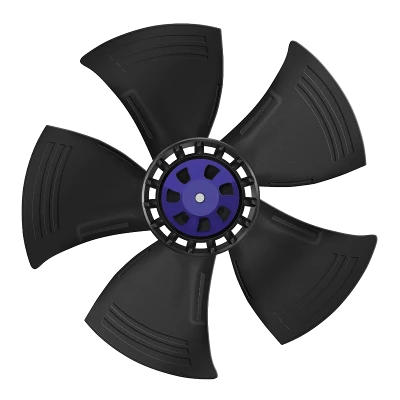
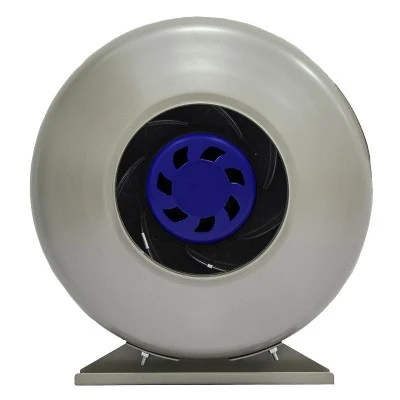
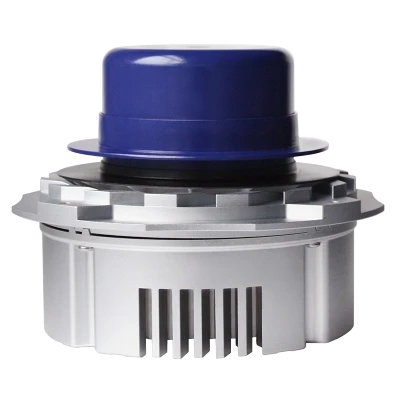
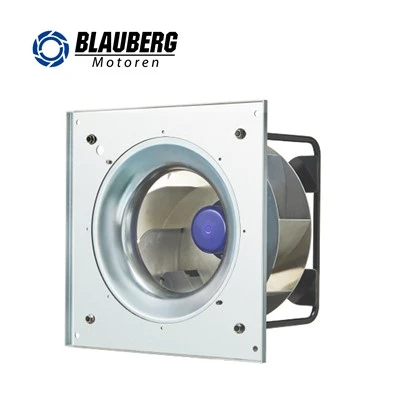
What is an EC centrifugal fan?
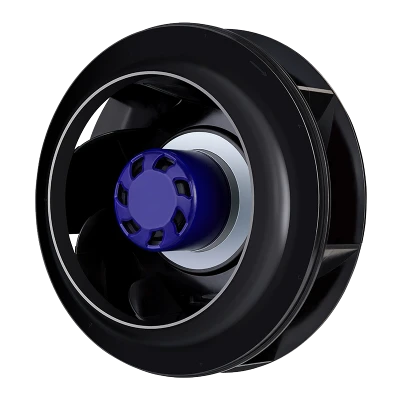
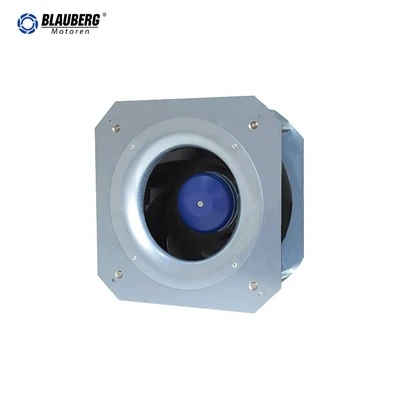
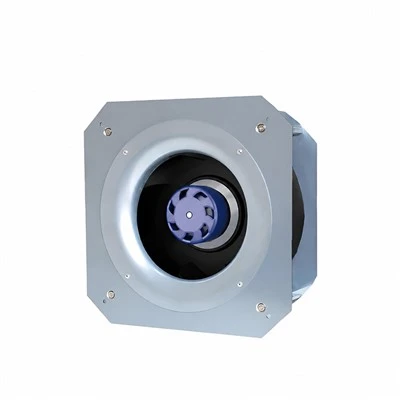
An EC centrifugal fan is a centrifugal fan driven by an electronically commutated (EC) motor — a brushless permanent-magnet DC motor with integrated electronics that runs directly from AC mains (1~115/230 V or 3~400/480 V). Because speed is controlled electronically rather than by a belt or external VFD, an EC centrifugal fan delivers 0–100% variable airflow, 15–30% lower energy consumption than an equivalent AC centrifugal fan, and integrated Modbus, 0–10 V or PWM control.
Backward curved vs forward curved centrifugal fan — which should I choose?
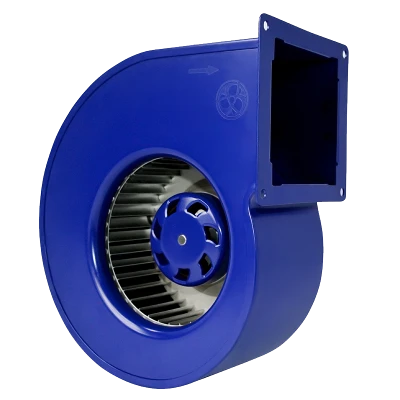
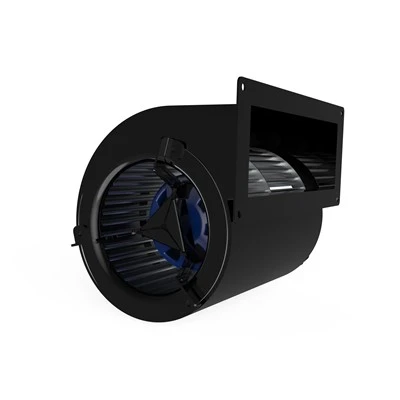
Choose a backward curved centrifugal fan when static pressure is above roughly 300 Pa (1.2 in. wg), efficiency and energy compliance matter, or the fan will sit inside an AHU, CRAC unit or fan wall as a housing-less plug fan. Choose a forward curved centrifugal fan (blower) when the application needs high airflow at low pressure in a very compact scroll housing — fan coil units, air curtains, ERV/HRV units and purifiers. Blauberg manufactures both with EC, AC and DC motors.
What is the difference between an EC plug fan and an EC plenum fan?
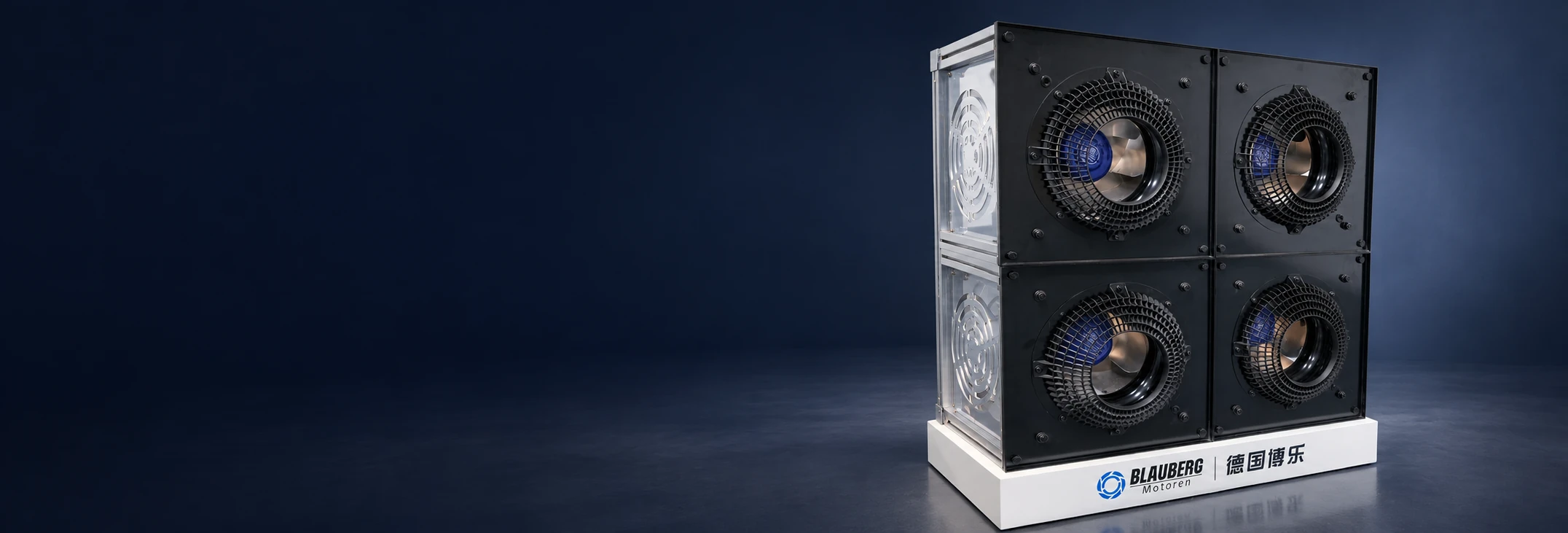
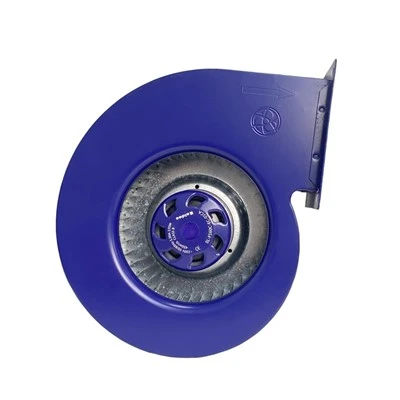
There is no technical difference: "plug fan" and "plenum fan" are two names for the same product — a backward curved centrifugal impeller and EC motor on a mounting plate that discharges radially into a plenum without a scroll housing. "Plug fan" is more common in Europe and Asia, "plenum fan" in North America. Multiple plug fans installed in parallel form a fan wall or fan array.
DC centrifugal fan vs EC centrifugal fan — what is the difference?
Both use brushless permanent-magnet motors. A DC centrifugal fan is powered from a low-voltage DC supply (typically 12, 24 or 48 V) and is used in appliances, EV chargers, battery storage and equipment cooling. An EC centrifugal fan contains its own rectifier and controller, so it connects directly to AC mains while still behaving like a variable-speed DC motor — the right choice for AHU, CRAC and HVAC equipment.
Why choose an EC backward curved fan over a forward curved AC fan?
Backward curved blades deliver a naturally "self-limiting" power curve — the motor cannot overload even if system resistance drops unexpectedly. Paired with an EC permanent magnet motor, the system sustains high efficiency (typically 70–85% total efficiency) across the full operating range, whereas an AC motor may drop to 40–50% efficiency at partial load. The result: 30–50% energy savings in real-world HVAC duty cycles.
Does retrofitting an AC fan require replacing the entire cabinet or housing?
Not with a Plug Fan (also called a "Free-Inlet" or "Plenum Fan") design. The impeller, EC motor, and electronics ship as a single pre-balanced assembly that mounts directly inside the existing AHU casing — no scroll housing needed. Mechanical interface adapters and custom mounting plates can be supplied to match legacy footprints, making most retrofits a half-day installation.
How does Modbus RS485 (or 0–10 V / PWM) control improve system uptime?
Digital protocols like Modbus RTU allow the fan to report speed, current draw, input power, and vibration status directly to your BMS or PLC in real time. This shifts maintenance from scheduled replacement to condition-based intervention — you act on an anomaly signal weeks before a bearing failure, rather than discovering the shutdown after the fact. Analog 0–10 V / PWM inputs remain available for simpler BMS integrations.
What is an "external rotor" motor and why does it matter for fan design?
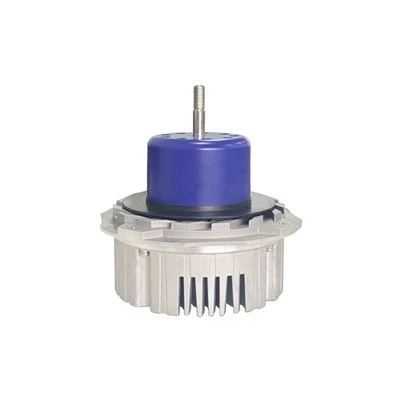
In an external rotor EC motor, the permanent magnet rotor is the outermost rotating shell, and the stator windings are fixed at the center. The impeller mounts directly onto this rotating outer shell — eliminating a separate shaft, coupling, and bearing housing. The result is a dramatically more compact and lighter assembly, shorter axial length, and inherently lower vibration because the rotor itself acts as a flywheel to damp imbalance.
What protection rating and service life can I expect?
Blauberg external rotor EC fans are built with IP55-rated sealed motors and precision imported bearings, rated for 40,000–50,000 hours of continuous operation — roughly 5–6 years at 24/7 duty, or well over a decade in intermittent HVAC service. The brushless EC commutation eliminates carbon brush wear, which is the primary wear-out mechanism in traditional AC motors.
Which certifications are required for different markets, and do your products carry them?
For North America, UL/ETL listing is the gateway requirement; CE + EMC + RoHS covers the EU and most export markets; CB certification enables acceptance across 50+ countries. Over 80% of Blauberg's EC fan range carries UL/ETL, CE, CB, and FCC certifications as standard, with ISO 9001 / 14001 / 45001 factory system certification. Specific compliance documents can be provided per SKU for project submissions.
How do I select the right fan model for my airflow and static pressure requirement?
Start with your system's design operating point (airflow in m³/h and static pressure in Pa). Use Blauberg's online Fan Selector tool to input these parameters alongside voltage, frequency, and any size constraints — the system auto-matches models and displays the fan curve with your operating point overlaid, plus efficiency and power data. For OEM projects with tight space envelopes or unique performance targets, custom impeller and motor combinations can be developed within 7–15 days.
Can EC centrifugal fans work with Building Management Systems (BMS) that use BACnet or other protocols?
Yes. While Modbus RTU over RS485 is the native embedded protocol, BACnet MS/TP and BACnet IP are accessible through a gateway module. For simpler installations, analog 0–10 V speed command and digital fault/run feedback signals cover the majority of BMS integration scenarios without additional hardware. Protocol specifications are available on request for controls engineers.
What are the main application sectors for EC backward curved centrifugal fans?
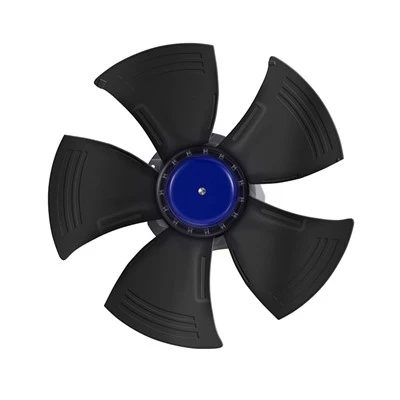
The primary verticals are: commercial AHU/FCU units, precision cooling for data centers, refrigeration evaporator and condenser sections, air purification and filtration cabinets, residential and light-commercial ERVs/HRVs, and industrial ventilation where variable flow and energy compliance (e.g., EU ErP Directive, US ASHRAE 90.1) are mandated. The self-limiting power curve and wide speed range make backward curved EC fans particularly well suited to VAV systems and inverter-driven AHUs.
What is the lead time, and can I get a sample before committing to a production order?
Standard catalog models ship within 15–25 days from order confirmation. Engineering samples for evaluation can be arranged within 7–10 days. For custom specifications — modified impeller diameter, non-standard voltage, special mounting — allow 7–15 days for prototype development before sample delivery. Minimum order quantities for custom variants are negotiable based on program volume.