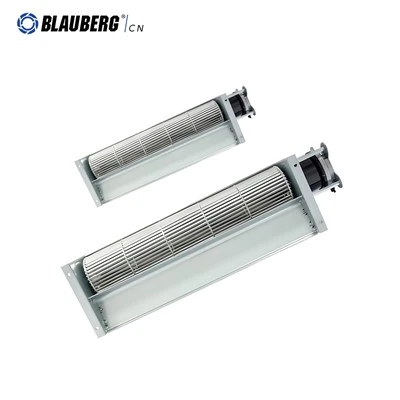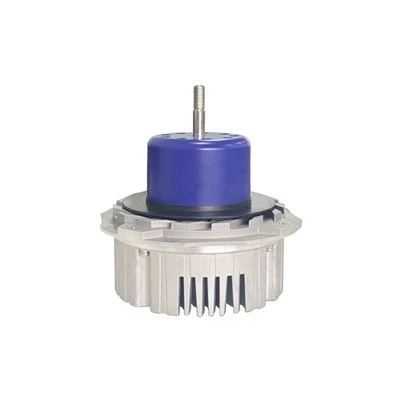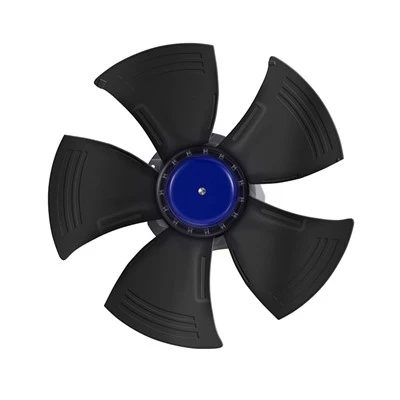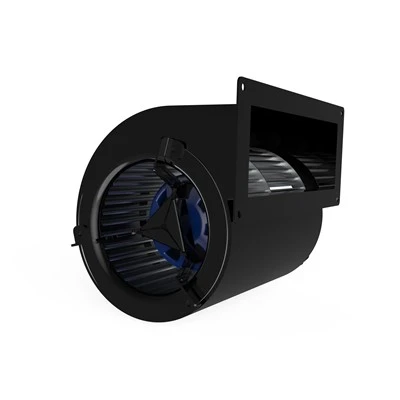
Cross-flow fans, also known as tangential fans or tangential blowers, operate differently from traditional axial fans in terms of airflow direction and design. Here's an explanation of how cross-flow fans work:
Design and Airflow Direction
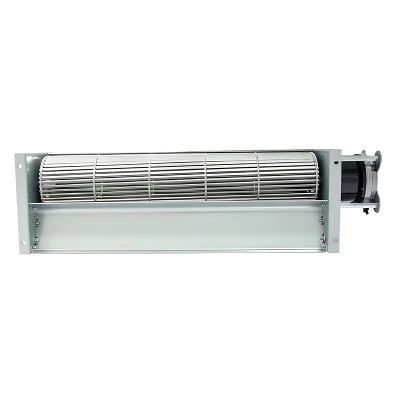
Blade Configuration: Cross-flow fans have blades arranged in a cylindrical housing that spans the width of the fan. These blades are curved or radial, often positioned at a slight angle to the direction of airflow. This design allows for a broad, uniform distribution of air across the entire length of the fan.
Airflow Direction: Unlike axial fans that draw air in parallel to the axis of rotation and expel it in the same direction, cross-flow fans draw air perpendicular to the axis of rotation and expel it in the same perpendicular direction but over a wider area. The air flows tangentially across the fan blades, hence the name "tangential fan."
Operating Principle
Air Intake: Air enters the cross-flow fan through the side intake. The shape and angle of the fan blades create a centrifugal force that draws the air inward toward the center of the fan.
Air Movement: As the fan blades rotate, they push the air across the fan's width rather than along its length. This movement creates a laminar flow pattern, where air moves in parallel layers with minimal turbulence.
Discharge: After passing through the fan blades, the air is discharged tangentially from the opposite side of the fan. This discharge pattern results in a more even distribution of airflow compared to axial fans, making cross-flow fans suitable for applications requiring gentle and uniform air circulation.
Applications and Benefits
Cooling Electronics: Cross-flow fans are commonly used for cooling electronics, such as in computer cases and refrigeration units, where space constraints or the need for directed airflow are critical.
Air Curtains: They are also utilized in air curtains and HVAC systems to create a barrier of air that separates different environments while allowing passage through doors or openings.
Compact Design: Their compact design and ability to provide airflow over a wider area make them suitable for applications where axial fans may not fit or where uniform airflow distribution is required.
Low Noise: Cross-flow fans typically operate at lower noise levels compared to axial fans, which is advantageous in environments where noise reduction is important.
In summary, cross-flow fans work by drawing air perpendicular to their axis of rotation, using centrifugal force to create a tangential airflow that is discharged evenly across their width. This design makes them versatile for various applications where gentle and uniform airflow distribution is essential.