BLAUBERG MOTOREN · EC AXIAL FAN
IP55 Protection and Wide-Voltage (100–277 V) Axial Fans for Global, Multi-Environment Applications
IP55 Protection · 100–277 V Wide Voltage · Multi-Environment Adaptation
Axial fans are widely used in condensers, dry coolers, heat pumps, telecommunications equipment, energy storage thermal management systems, and industrial ventilation equipment. As equipment manufacturers expand into international markets, a single product platform may need to accommodate supply voltages such as 100 V, 120 V, 230 V, or 277 V. It may also be exposed to dust, moisture, rain, and temperature fluctuations over extended periods.
Under these conditions, airflow and pressure are only part of the fan selection process. Power supply compatibility, environmental protection, and control capabilities also affect equipment design, installation, and long-term operation.
For applicable EC axial fan models, IP55 protection and a 100–277 V wide-voltage input address two different requirements: environmental protection and electrical compatibility. Both specifications have defined technical limits. They should not be interpreted as meaning that the fan can operate with any power supply or under all outdoor conditions.
What Does IP55 Protection Mean?
IP ratings are defined by IEC 60529, which classifies the degree of protection provided by electrical enclosures. The first digit indicates protection against the ingress of solid objects, while the second digit indicates protection against water ingress.
In an IP55 rating, the first digit, "5," indicates dust protection. Some dust may enter the enclosure, but not in quantities sufficient to interfere with normal operation or safety. The second digit, also "5," indicates protection against water jets from any direction under the test conditions specified by the standard. Water ingress must not produce harmful effects.
IP55 can therefore improve a fan's suitability for environments involving ordinary levels of dust, humidity, and water spray. Typical applications may include outdoor heat rejection equipment, industrial ventilation systems, and cooling systems for electronic equipment. Compared with motors intended primarily for dry indoor environments, an IP55 design places greater emphasis on the sealing of the motor enclosure, terminal area, and cable entry.

IP55 describes an enclosure's resistance to dust and water jets. Actual protection also depends on the sealing structure, cable entry, and installation method.
IP55 does not mean that the enclosure is completely sealed. It also does not indicate suitability for continuous immersion or direct high-pressure cleaning. Coastal salt spray, chemically corrosive atmospheres, standing water, and persistent condensation require further evaluation of blade materials, surface treatments, fasteners, cable weather resistance, and terminal enclosure design.
Installation Affects Protection in Practice
An IP rating is verified under defined test conditions. After the fan is installed in a complete unit, its effective protection can also be influenced by equipment design and installation quality.
Loose cable glands, incorrectly seated seals, or improperly secured terminal covers may compromise the intended protection of the motor. If a horizontal installation allows water to collect around the fan, prolonged exposure may also accelerate the deterioration of coatings, fasteners, and sealing materials. Outdoor equipment should therefore incorporate suitable rain protection, drainage, and airflow management to prevent water from striking cable entries directly or remaining around the motor.
Temperature changes after shutdown also require attention. Warm, humid air inside the equipment may condense as the unit cools. If the terminal area lacks an appropriate drainage path, or if large temperature differences persist across the motor enclosure, condensation may present a less visible but recurring risk.
In dry coolers and condensers, the airflow path may carry rain droplets and airborne particles into the unit and deposit them on the heat exchanger surface. The overall equipment design should therefore consider weather protection, louvers, guards, and drainage channels. In applications with a high dust load, filtration may also be considered, provided that its effect on system resistance and maintenance requirements is taken into account.
IP55 defines a basic protection level for the electrical enclosure. It does not replace weather-resistant design at the complete-unit level.
How a 100–277 V Wide-Voltage Input Supports Different Markets
Single-phase supply voltages vary between countries and regions. Some markets commonly use 100 V or 110–120 V, while others use 220–240 V. A 277 V single-phase supply is also found in certain North American commercial building systems.
If a fan is designed for only one rated voltage, equipment manufacturers may need several motor versions, each with separate part numbers, wiring arrangements, inventory, and service requirements.
In a single-phase EC axial fan rated for a 100–277 V input range, the integrated electronics perform rectification, electronic commutation, and motor control within the specified voltage and frequency limits. This allows one fan platform to accommodate several regional single-phase power systems, potentially reducing the number of electrical variants required for exported equipment and simplifying spare-parts planning.

A 100–277 V wide-voltage input allows applicable EC fan models to support several regional single-phase power systems. The supply phase, frequency, and wiring requirements must still be verified against the relevant technical documentation.
A wide input range does not guarantee identical output capability at every supply voltage. At a lower input voltage, maintaining a similar output power generally requires a higher input current. This increases the current load on the electronics, cables, and protective devices. Near the lower end of the voltage range, the maximum speed, available output power, or permitted ambient temperature may be restricted for some models.
Fan selection should therefore consider more than the stated 100–277 V range. Rated current, input power, frequency range, power factor, protective earthing, and any voltage-dependent derating conditions must also be checked.
A 277 V supply usually refers to a specific single-phase application. It must not be confused with a three-phase 380–480 V supply.
Combining Wide-Voltage Operation with Demand-Based EC Control
An EC motor uses electronic commutation to regulate motor torque and speed. Depending on the model, the fan may support 0–10 V or PWM speed control, speed feedback, or communication via Modbus/RS485. Interface definitions, signal levels, and wiring requirements should always be confirmed in the product documentation.
In condensers and dry coolers, ambient conditions and heat rejection loads vary over time. If a fan continuously operates at maximum speed, the airflow may exceed the actual system requirement. When the load decreases, adjusting fan speed in response to temperature, pressure, or equipment control signals can reduce unnecessary airflow. Input power and aerodynamic noise will generally decrease as speed is reduced, although the actual change should be evaluated using fan performance curves and test data.
EC drives contain power electronic components whose operating conditions depend on ambient temperature and available cooling. High temperatures or insufficient heat dissipation can increase the drive temperature and may activate power limiting or overtemperature protection. Applications involving frequent starts and stops should also be checked against the permitted switching method, switching frequency, and control requirements specified for the product.
Selection for demanding conditions should therefore consider the permitted ambient temperature, temperature-dependent derating, and protective functions such as overload and locked-rotor protection.
Outdoor Operation Also Requires Corrosion and Temperature Assessment
Water and dust are not the only environmental factors affecting outdoor fans. Salt spray in coastal areas, corrosive gases in industrial locations, low winter temperatures, and high summer temperatures can all affect the impeller, motor, bearings, fasteners, and electronic components.
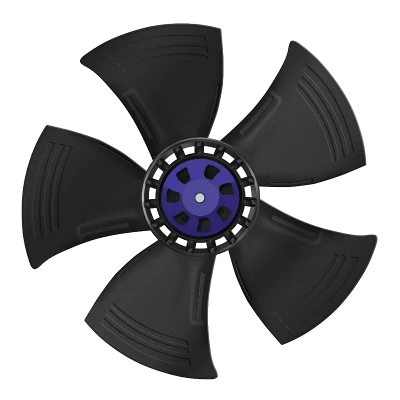
Materials respond differently to these conditions. For engineering-plastic blades, the specified temperature range, ultraviolet ageing resistance, and long-term dimensional stability should be reviewed. Metal parts require appropriate coatings or plating, along with consideration of galvanic corrosion. Where large day-to-night temperature changes occur, thermal expansion and contraction may affect blade tip clearance, mechanical joints, and sealing components.

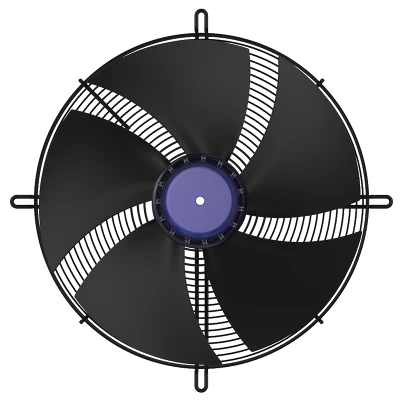
Axial fans in outdoor heat rejection equipment may be exposed to rain, humidity, dust, and temperature fluctuations. The complete unit should also incorporate suitable drainage, weather protection, and corrosion-resistant construction.
In a typical induced-draft dry cooler or condenser with top-mounted fans, air enters through the sides or lower part of the heat exchanger, passes through the coil, and is discharged upward by the axial fans. Restricted inlet clearance, fouled coils, or an obstructed fan outlet can change the actual airflow and may increase both noise and operating load.
IP Protection and Wide Voltage Do Not Replace Operating-Point Selection
IP55 and 100–277 V describe environmental protection and power supply compatibility. They do not directly indicate the airflow that a fan will deliver after installation.
Once an axial fan is installed, the coil, fan guard, louvers, any filtration components, and the internal airflow path all contribute to system resistance. The intersection of the fan performance curve and the system resistance curve determines the actual operating point.
If the operating point falls outside the intended region, the fan may experience unstable airflow, reduced efficiency, or increased noise. In multi-fan systems, engineers should also assess fan spacing, recirculation, reverse rotation of inactive fans, and uneven airflow distribution.
At high altitudes, lower air density affects available pressure, heat transfer performance, and motor cooling. These effects must be considered during fan and equipment selection.

The intersection of the fan performance curve and the system resistance curve determines the actual operating point. Neither the IP rating nor the input voltage range replaces aerodynamic selection.
A reliable selection process should consider the required airflow, system pressure requirement, input power, rotational speed, acoustic data, ambient temperature, and available installation space. Appropriate allowance should also be made for heat exchanger fouling and changes in operating conditions.
Moving from Individual Specifications to System Compatibility
For equipment intended for multiple international markets, a 100–277 V wide-voltage input can reduce some electrical adaptation requirements, while IP55 provides a basic level of protection against dust, moisture, and water jets.
When the operating point, ambient temperature, installation conditions, and relevant certification requirements are properly addressed, these features can broaden the suitability of EC axial fans for outdoor heat pump units, condensers, dry coolers, telecommunications infrastructure, and industrial ventilation equipment.
In developing EC axial fans, Blauberg considers impeller aerodynamics, motor drive technology, enclosure protection, and control interfaces as parts of an integrated product system. Equipment manufacturers should still verify the rated voltage, IP classification, permitted ambient temperature, control options, and performance curves for the specific model being selected.
Reliable operation in demanding environments cannot be determined by a single specification. IP55 must be supported by correct installation, drainage, and corrosion protection. Wide-voltage capability must be assessed together with current, power, and local electrical requirements. Fan performance must ultimately be evaluated at the actual operating point.
By considering electrical supply, environmental exposure, aerodynamics, and control requirements within the same selection framework, engineers can make effective use of the adaptability offered by wide-voltage EC axial fans.