Blauberg Motoren · Engineering guide
Should your cross flow fan use AC, DC or EC drive?
Choose a cross flow fan drive by the power source available in the equipment, the required control behaviour and the installed operating duty. Compare the proposed variants using their documented supply ratings, wiring diagrams and control specifications. Confirm the exact model's input and signal documentation before making an energy, compatibility or control decision.

How should you organize the drive documentation?
For a design review, put the input source in one column and the documented motor technology in another. Add a third column for control and feedback. This avoids treating an electrically compatible supply as proof that the fan will understand the equipment's speed command.
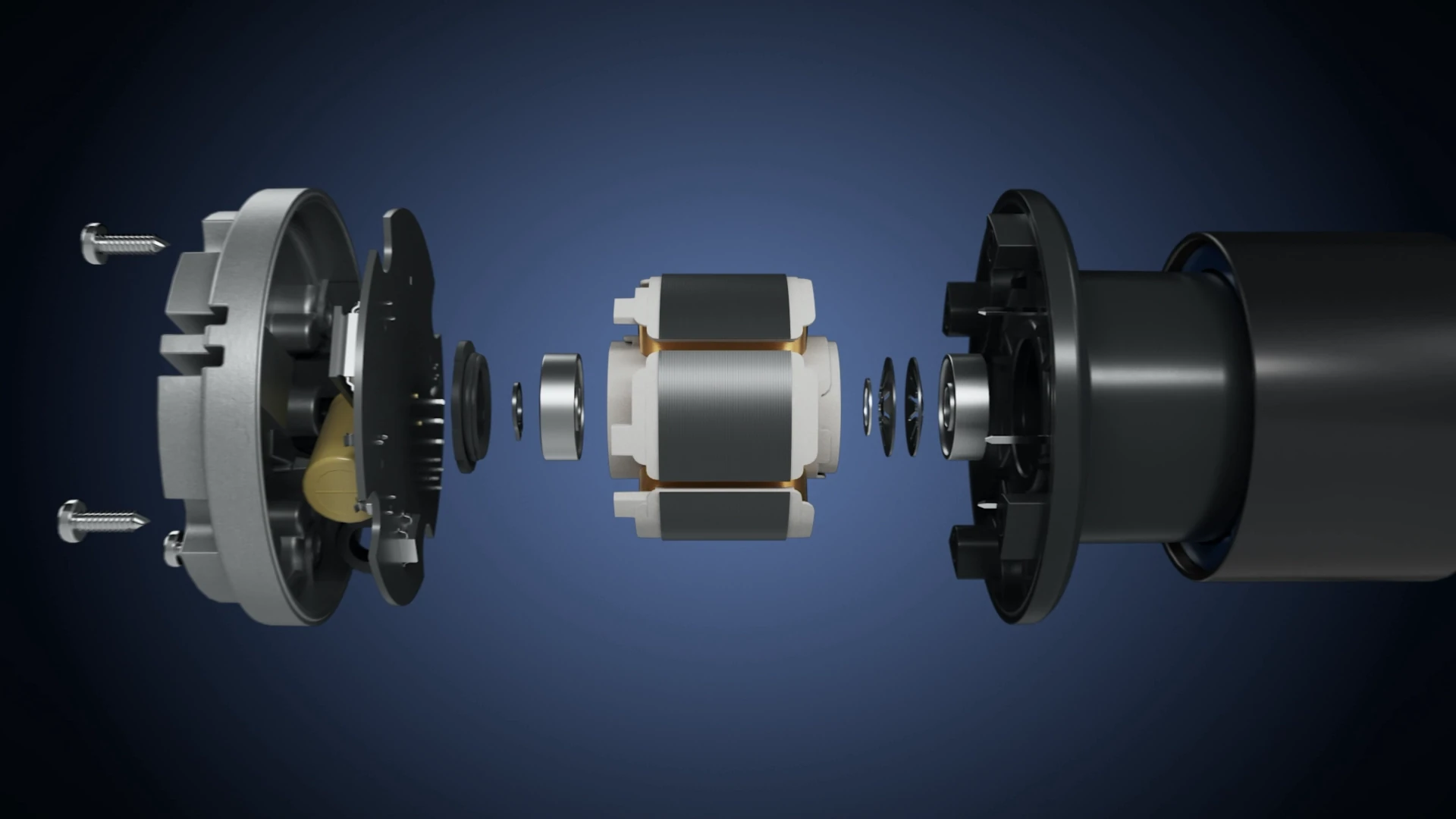
The exploded view introduces the motor as a distinct part of the fan assembly. Confirm the actual supply, commutation and controller requirements from the selected drive documentation.
Source: Blauberg product-animation frame, 18 seconds. Conceptual component arrangement.
What should you compare across the three catalogue categories?
Compare what your equipment needs and what the proposed variant actually documents. The following original interface matrix is a purchasing and engineering aid; it does not assert that every product in a category includes the listed features.
| Catalogue description | Supply question | Control question | Evidence needed before selection |
|---|---|---|---|
| AC cross flow fan | Which voltage and frequency does this variant accept? | Which speed-control method, if any, is explicitly allowed? | Rating, wiring diagram and supported control method |
| DC cross flow fan | Which nominal DC voltage and supply limits apply? | Is control by a dedicated input supported, and what is its definition? | Input specification, motor description and interface data |
| EC cross flow fan | Does the assembly require AC mains or DC input? | Which command and feedback options are fitted to this order code? | Input rating, connection diagram and variant-specific options |
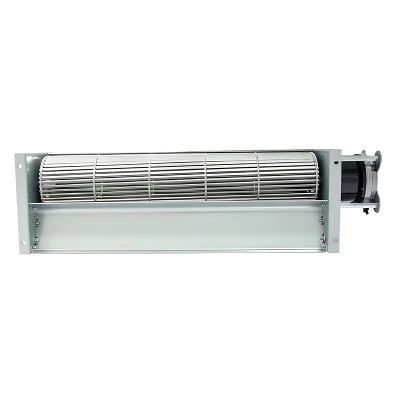
Blauberg's cross flow fan range uses AC, DC and EC categories. As a limited catalogue example, the series page accessed 22 September 2026 lists VF-T030A-EE-1082(R002) as 12 V DC. That identifies a supply category; it does not establish PWM capability, a feedback output or compatibility with an arbitrary controller. Treat a search for a 12 V DC cross flow fan as the start of that check.
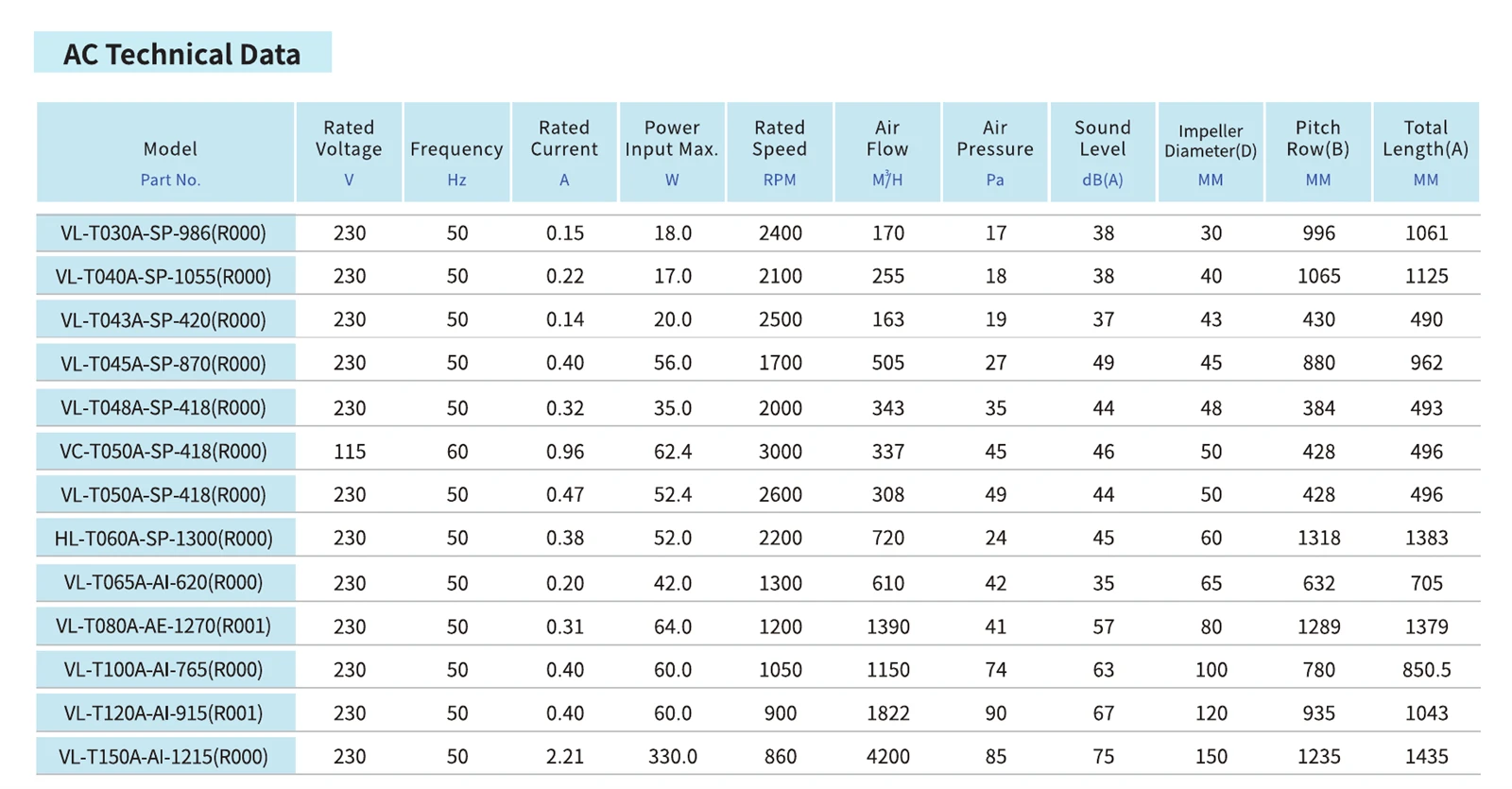
The AC table retains the model-specific voltage, frequency, input, speed and dimensional columns. Compare the exact row relevant to the equipment supply instead of assigning one electrical specification to every AC fan.
Source: Blauberg Cross Flow Fan | 2025 brochure, PDF page 2, AC Technical Data. Published catalogue data.
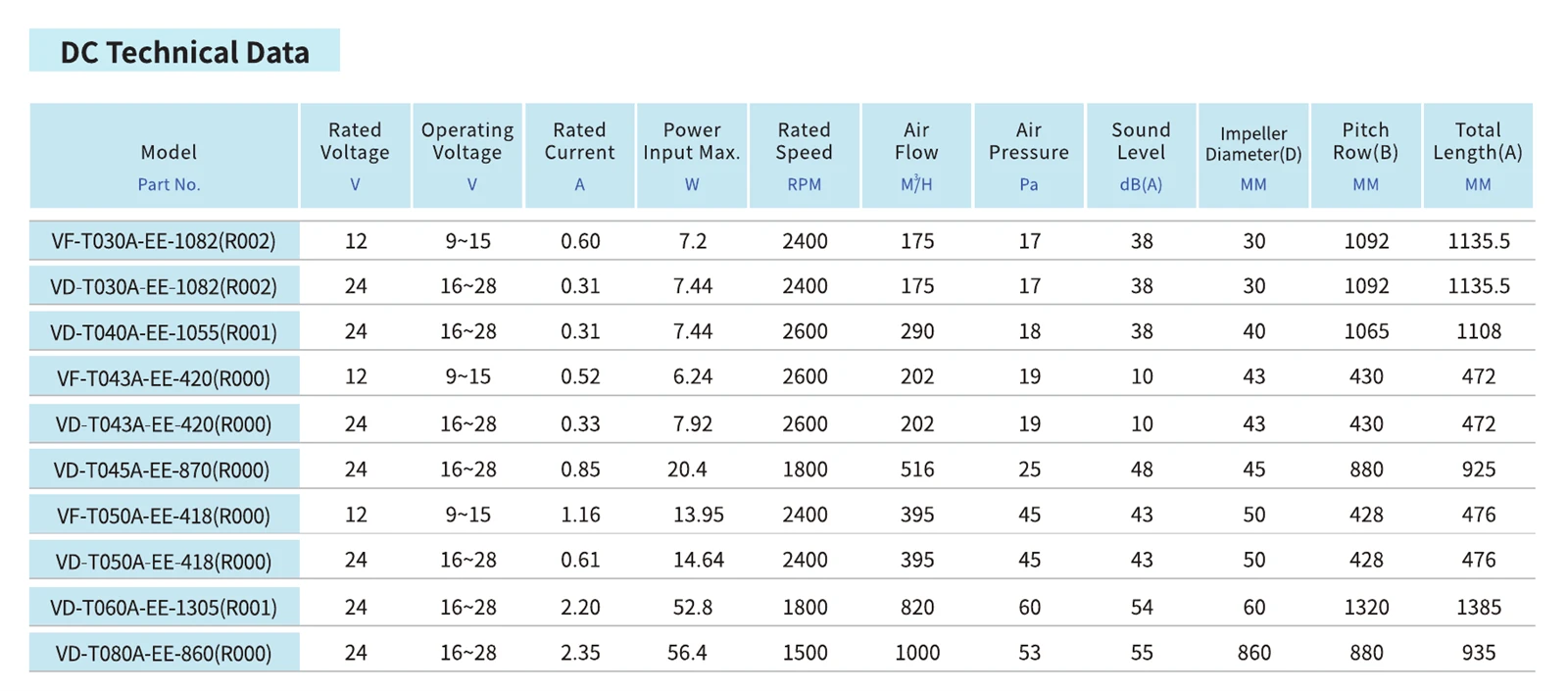
The DC table distinguishes rated voltage from operating voltage range. Keep both fields in the electrical review, together with the specific model's current, input and speed entries. The impeller-diameter entry for VD-T080A-EE-860(R000) needs confirmation against the current model drawing before dimensional selection.
Source: Blauberg Cross Flow Fan | 2025 brochure, PDF page 2, DC Technical Data. Original table reproduced without correcting its entries.
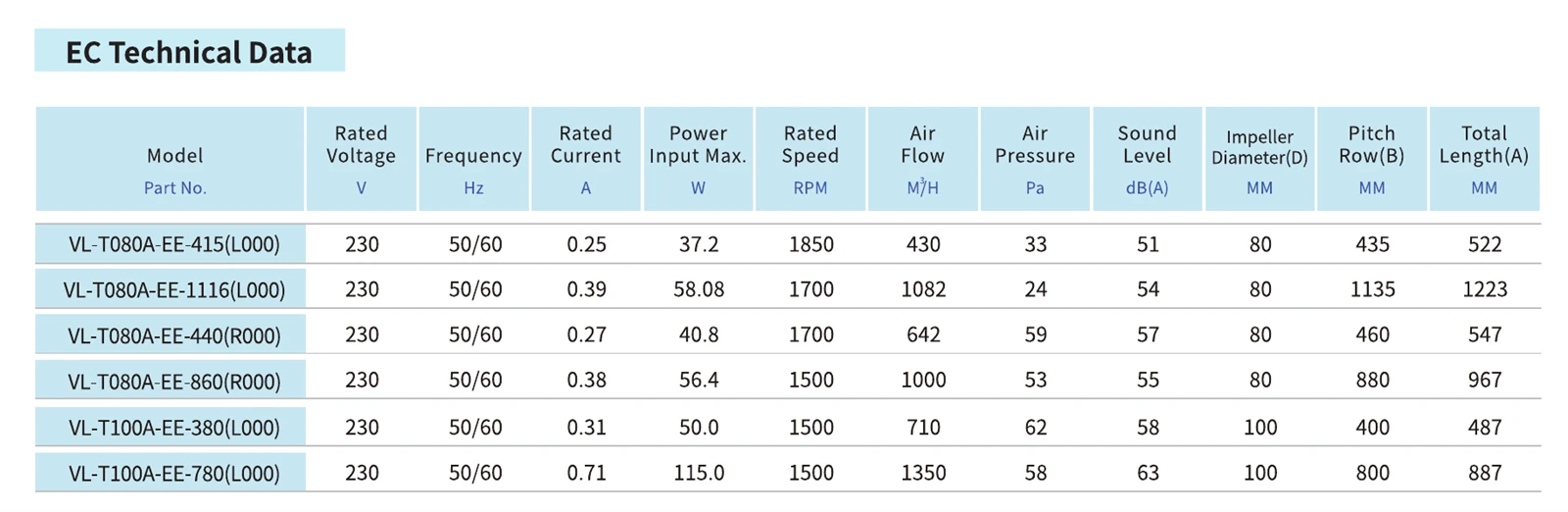
The EC table provides the third set of model records for the category comparison. A category label does not establish a control signal, speed range or efficiency advantage for the intended operating duty.
Source: Blauberg Cross Flow Fan | 2025 brochure, PDF page 1, EC Technical Data. Published catalogue data.
How do you verify the speed-control interface?
Begin with a model-specific connection record: full order code, connector, pinout, wire functions, signal limits and the supplier's document revision.
Make the control review behavioural. Specify what should happen at the lowest requested speed, at a stop command, when the command is missing and after a power interruption. Ask the supplier which behaviours the model supports, then include those conditions in the equipment validation plan. Do not infer a stopped rotor from a command value without checking the documented response.
If two product versions use the same connector shell, still verify their pinouts and signal levels independently. Keep the approved connection diagram with the order code. That small document link is valuable when a later purchasing substitution appears mechanically identical.
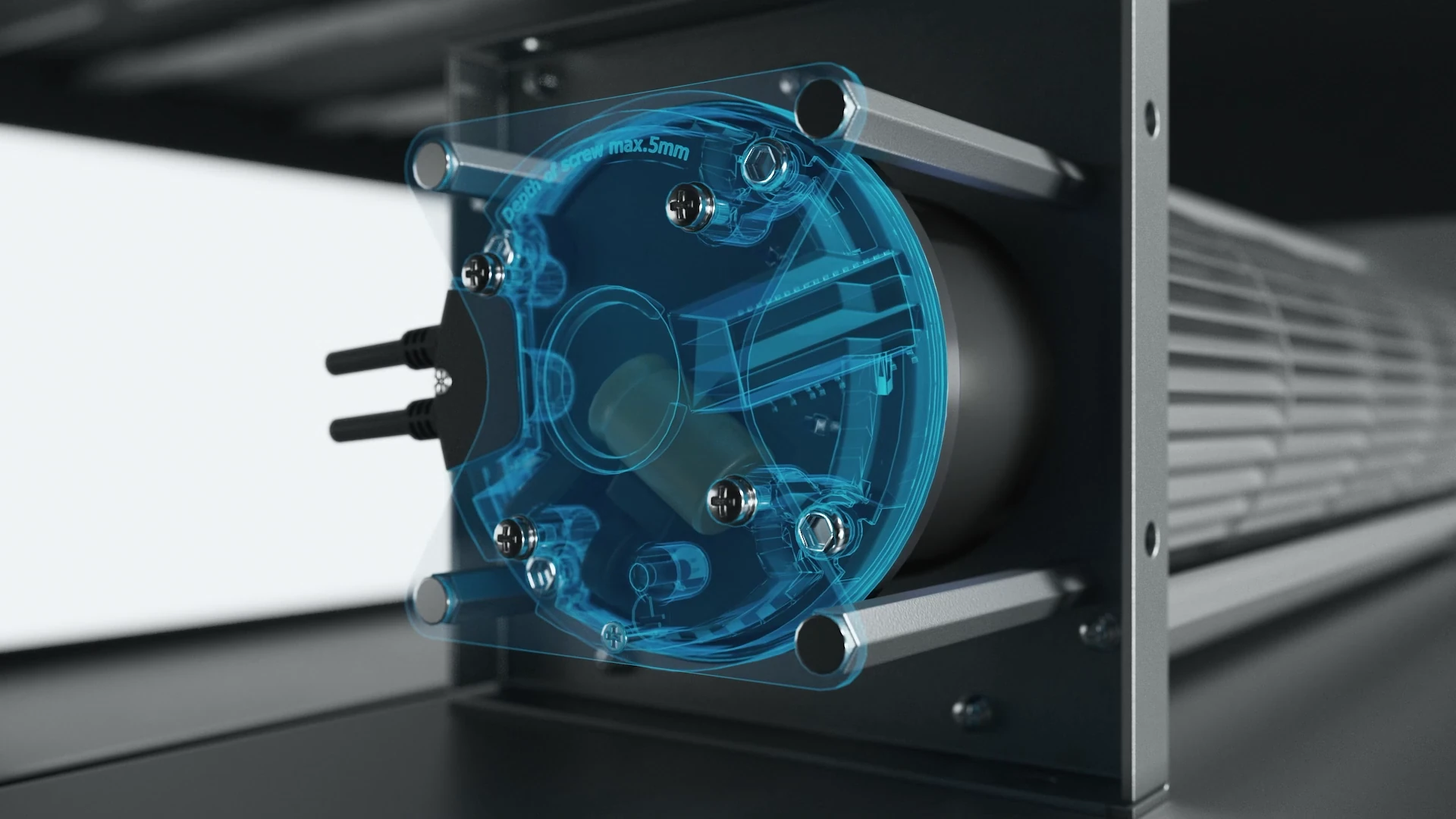
The close-up locates the motor and connection area. The transparent overlay is a visual explanation of the product; use the actual wiring diagram to verify signal names, pin assignments and permitted control settings.
Source: Blauberg product-animation frame, 26 seconds.
Which cross flow fan models should you review?
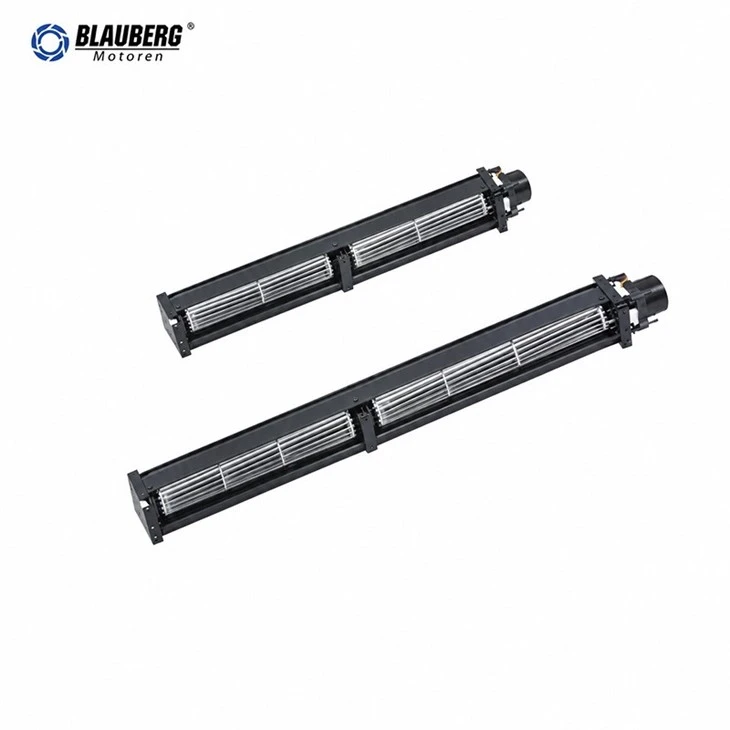
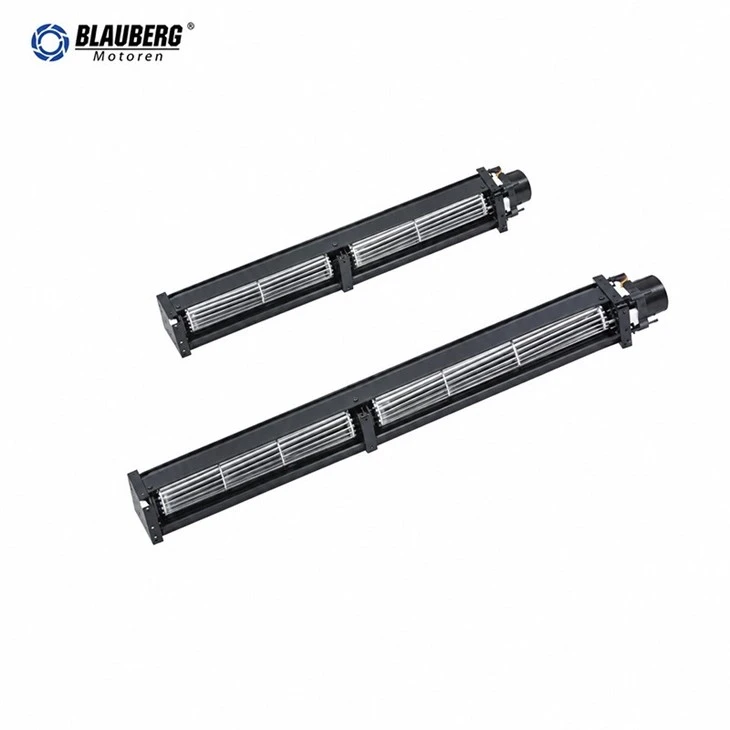
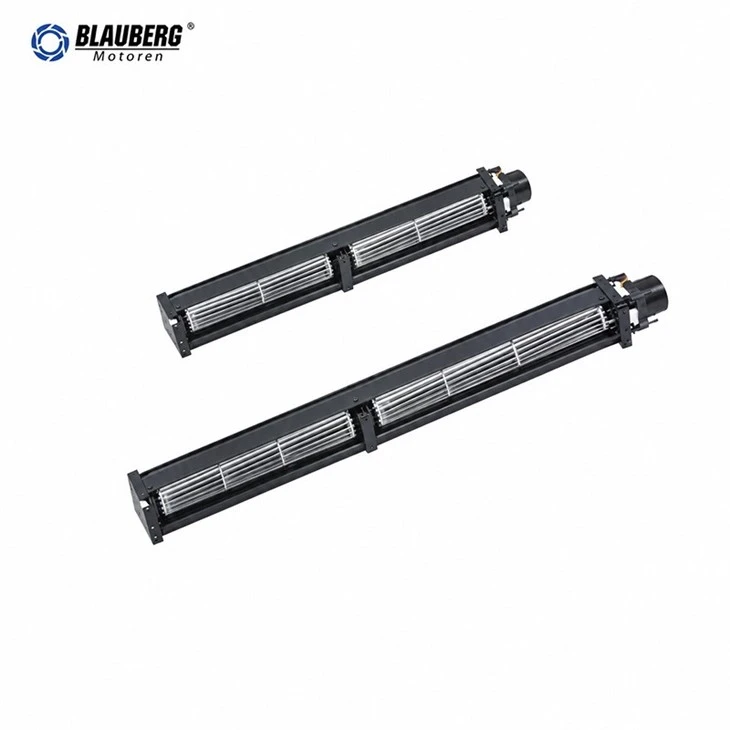
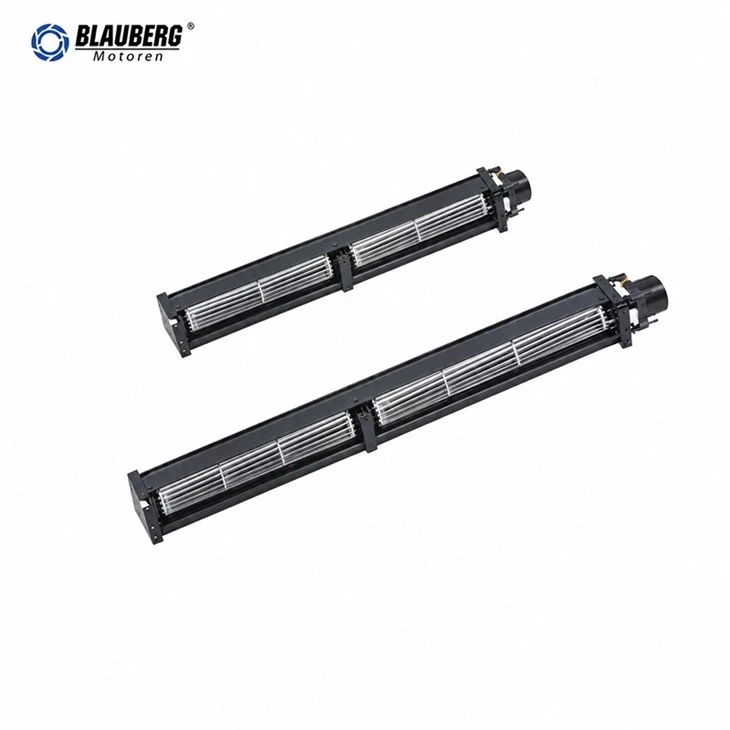
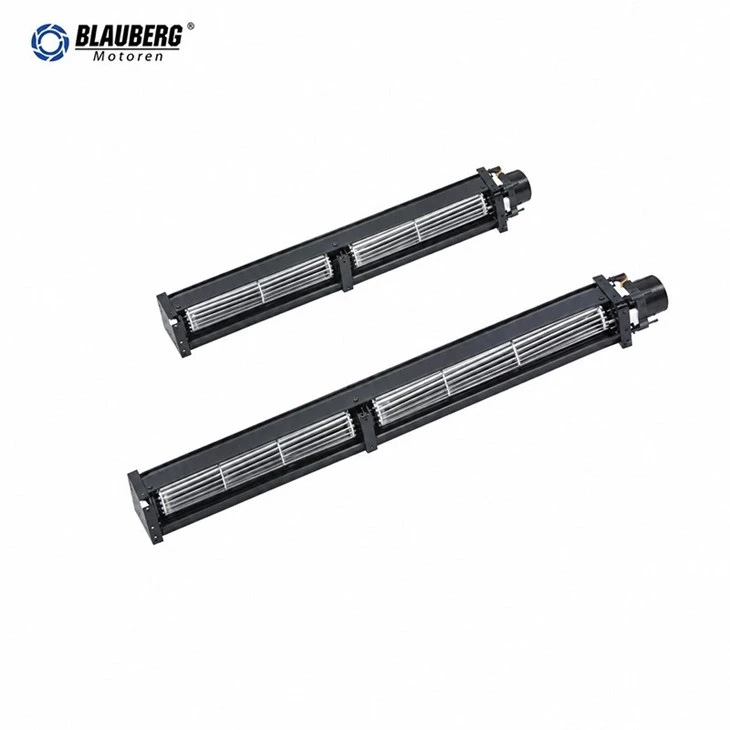
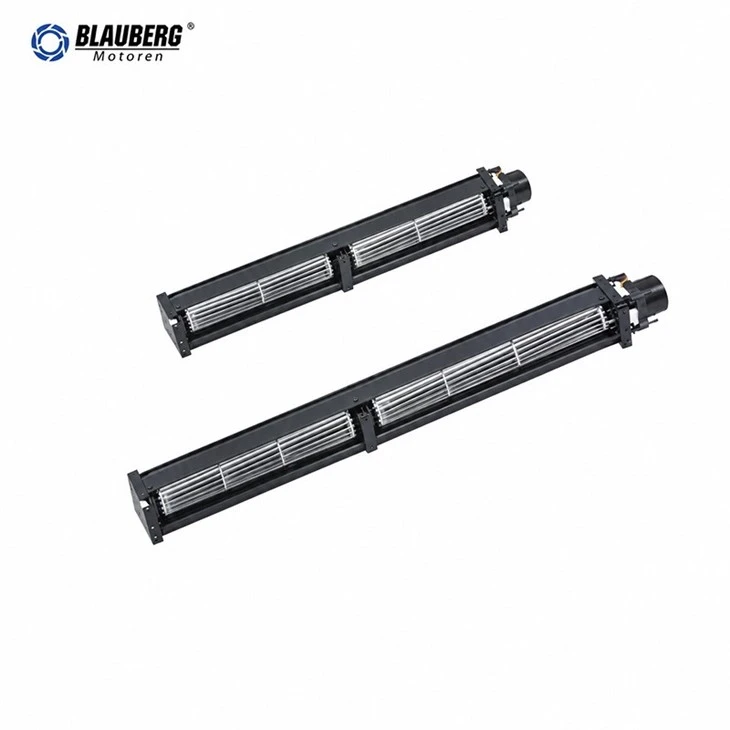
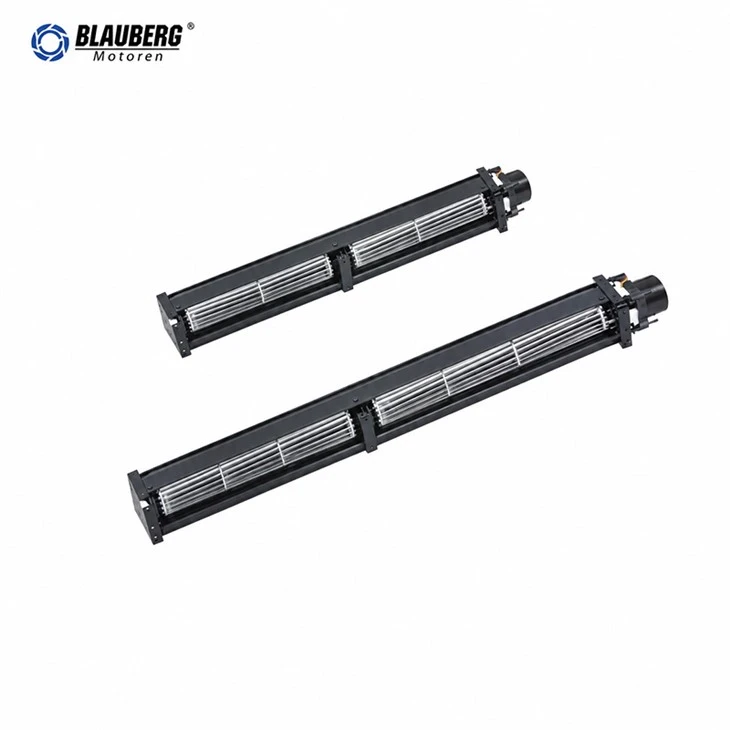
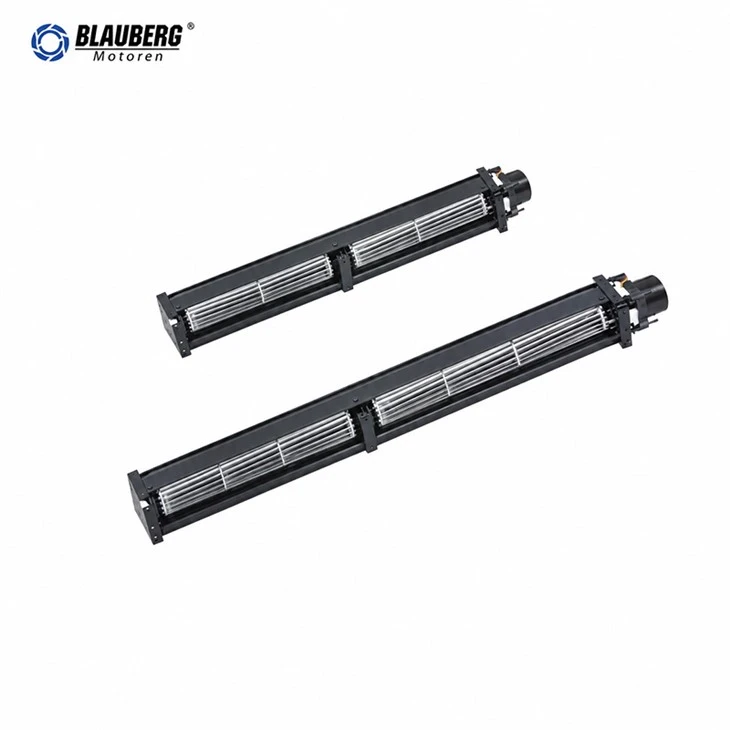
Product descriptions from the Blauberg catalogue, checked 22 September 2026. Listed airflow and pressure maxima are separate ratings; confirm the selected model at your operating point.
How can you compare energy without comparing different jobs?
Compare electrical input while both assemblies deliver the same required service, including the specified airflow and pressure in the same installation. If one candidate supplies less air, its lower electrical input is not enough to establish a useful efficiency advantage. Record the measurement boundary as well: a DC power-supply loss included in one result and excluded from another would make the comparison inconsistent.
Illustrative assumptions, not Blauberg measurements: suppose two complete supply-and-fan assemblies meet the same project duty. Assume assembly A draws 30 W and assembly B draws 18 W at that duty, and each operates for 1,600 hours. Energy is power multiplied by time: A uses 48 kWh and B uses 28.8 kWh, a difference of 19.2 kWh for the assumed period. These invented inputs demonstrate the calculation only; they describe no identified Blauberg model or proven saving.
For a variable-speed product, repeat the calculation by operating mode using documented hours and measured input. Include standby where it matters to the equipment requirement. Keep purchase cost, controls and validation effort in a separate decision column; a motor label alone does not establish the commercial outcome.
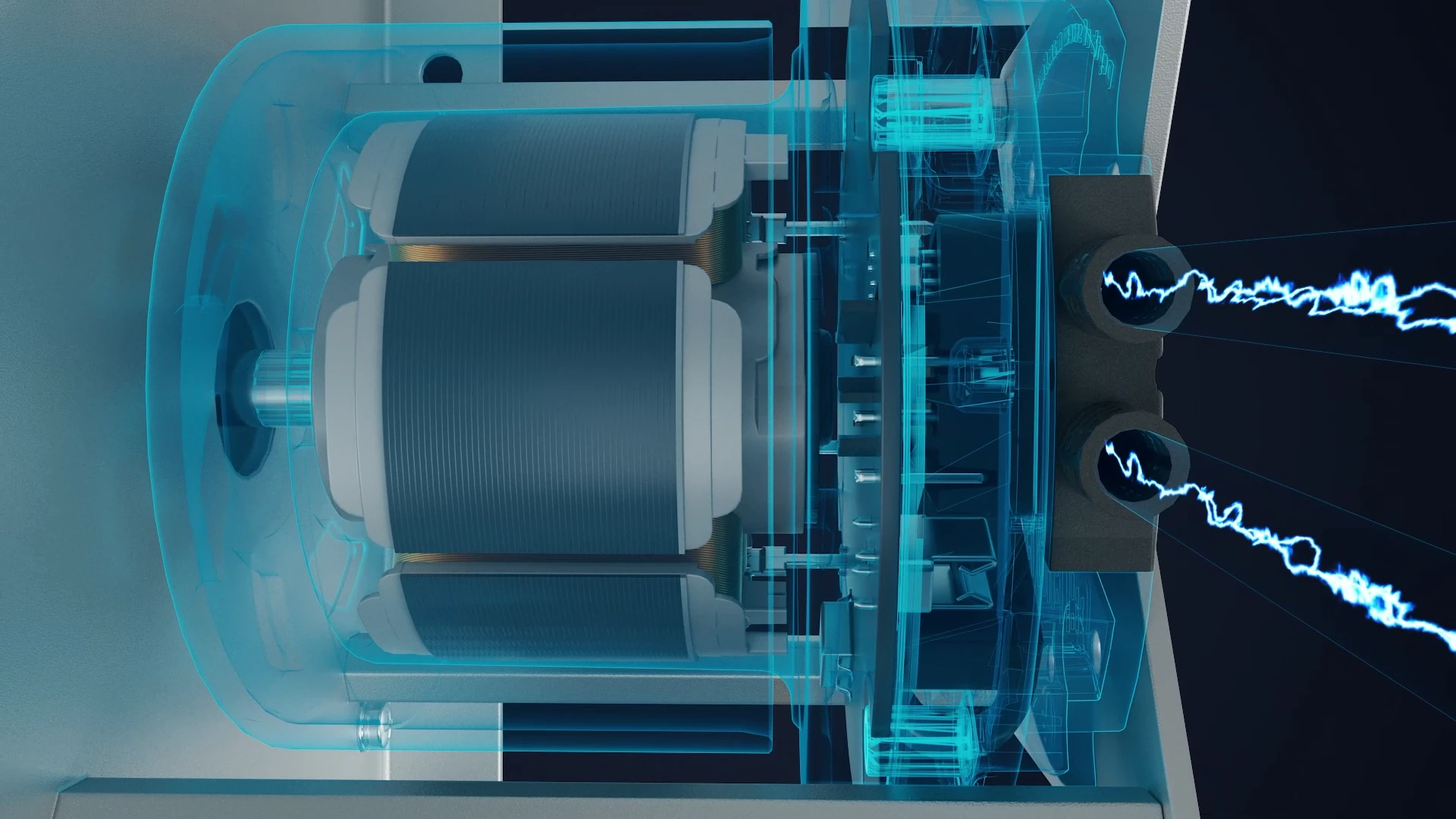
The cutaway visualizes the drive assembly. Its electrical effects do not quantify efficiency or energy savings; compare recorded electrical input only when the candidates provide the same useful service.
Source: Blauberg product-animation frame, 24 seconds. Marketing illustration, not an energy test or electromagnetic simulation result.
Which operating behaviours should the sample demonstrate?
Validate the sample against the intended equipment sequence. Continuous operation, frequent starts and a wide modulation range create different questions for the review, even if the nominal supply is identical. State the sequence and environmental conditions, then ask the supplier to confirm suitability for the specific model.
Use a run record that connects the command, observed response, airflow, electrical input and acoustic condition. At a low command, record whether the assembly starts and continues to meet its required function. At a change in demand, record the response expected by the equipment controller. These are proposed validation tasks, not claims that a particular fan has passed them.
The downloadable interface worksheet keeps power supply, motor technology and control evidence separate. It also reserves a place for the exact document revision and the observed result, helping the electrical and mechanical teams review the same candidate.
What should decide the final drive choice?
Choose the documented variant that meets the equipment's airflow, packaging, electrical and control requirements with an acceptable validation burden. An existing DC bus may make a DC-input candidate convenient; a mains-powered product may favour a compatible AC-input assembly. These are system choices, subject to the exact ratings and the performance at the required duty.
Bring the completed interface matrix and operating sequence to Blauberg's product-selection discussion, alongside the candidate from the cross flow fan catalogue. Request confirmation of the supply, pinout, control options and outstanding prototype checks before freezing the order code.
What should you record before making a decision?
Original editorial record for comparing proposed variants. It does not confirm the features of any unreviewed SKU or represent completed electrical testing.
This original worksheet is a record template, not a completed measurement report, certification procedure or manufacturer-approved service instruction. Define project acceptance criteria before testing; leave unmeasured values blank.
Download the editable CSV worksheet| Check | What to record | Acceptance basis |
|---|---|---|
| Variant identity | Full order code; option suffixes; document revision | Supplier-confirmed variant |
| Input source | AC or DC; nominal voltage; required limits | Equipment supply and model rating |
| Mains frequency | Applicable frequency rating for AC input | Specific model documentation |
| Motor technology | Documented commutation; do not infer from DC label | Model technical description |
| Connections | Connector; pinout; wire functions; reference connection | Approved model-specific diagram |
| Speed command | Supported method; input limits; command interpretation | Controller specification and fan interface data |
The download contains all 13 checks and a blank result column for your project.
What else should you check?
Can an EC cross flow fan connect to AC mains?
Only if the exact model documentation permits it. Check the voltage and frequency ratings and connection diagram. Do not connect a candidate based only on the catalogue category.
Does a DC fan automatically support PWM speed control?
No. Request the supported control method and signal limits for the intended variant before designing the controller interface. Keep the confirmation with the exact order code and document revision.
Can I compare energy from the rated watts in two catalogue rows?
Those rows can help screen candidates, but an energy comparison needs the same delivered service and a consistent measurement boundary. Use the intended operating modes and hours, then compare electrical input under those conditions rather than assuming the catalogue ratings describe equal duties.
Is a zero-speed command the same as isolating electrical power?
No. A control command and electrical isolation are different states. For installation or service, follow the specific equipment instructions and isolation procedure; the visible state of the rotor or the command value does not replace that procedure.
Sources and scope
Sources checked on 22 September 2026. Published catalogue values describe the cited models only. This article provides an engineering decision framework; it does not report a new Blauberg laboratory test.
- Blauberg Motoren cross flow fan catalogue - Catalogue categories and 12 V DC identification for VF-T030A-EE-1082(R002), accessed 2026-09-22.
Category of Blauberg Products
Built on German engineering principles, focusing on precision, reliability, and long-term performance. Through efficient and scalable manufacturing, we deliver high-quality ventilation solutions with optimized cost structure, ensuring strong value for global OEM and project-based customers.