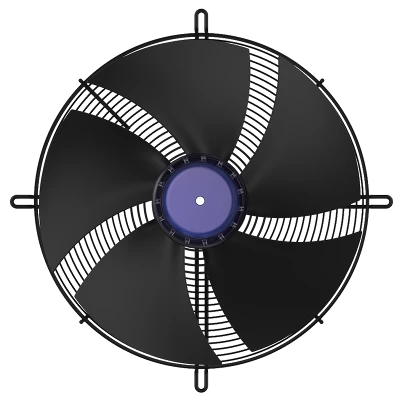
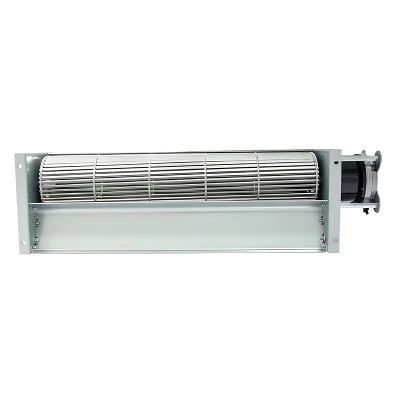
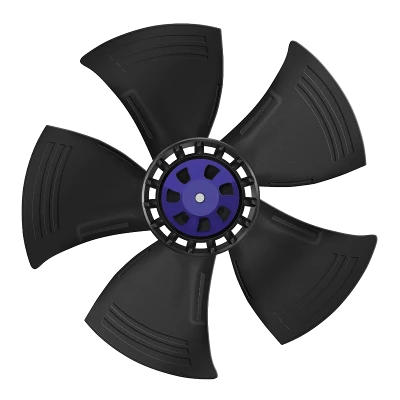
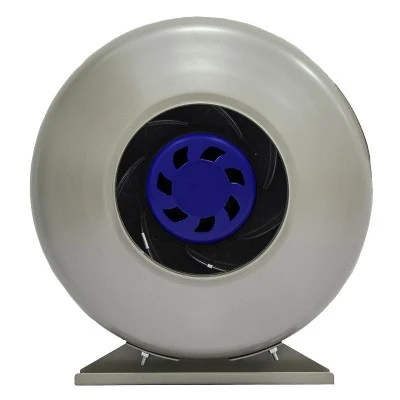
When it comes to industrial and household ventilation, two popular fan types stand out: Centrifugal fans and cross flow fans. Both are essential in various systems that require air movement, yet they differ significantly in their design, operation, and application. In this article, we will explore the operational differences between centrifugal fans and cross flow fans, and discuss the most suitable use cases for each type.
What is a Centrifugal Fan?
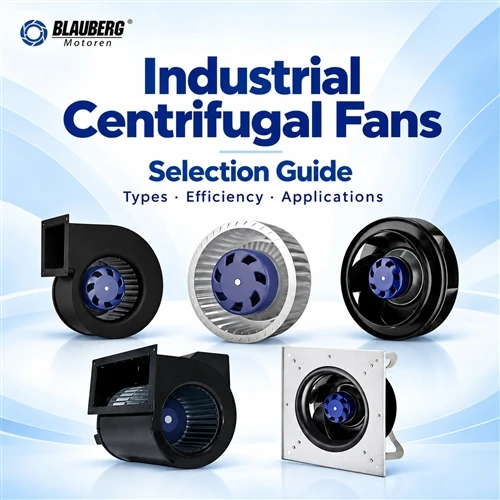
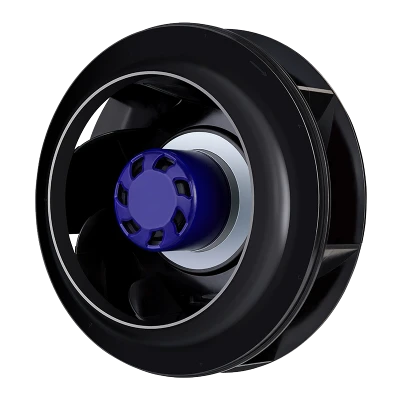
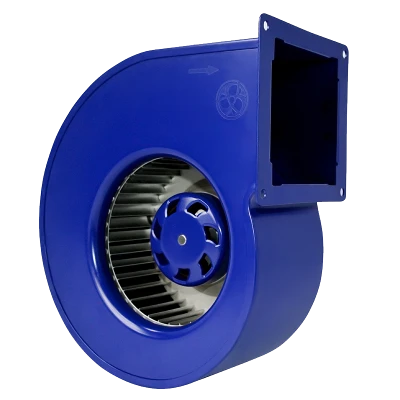
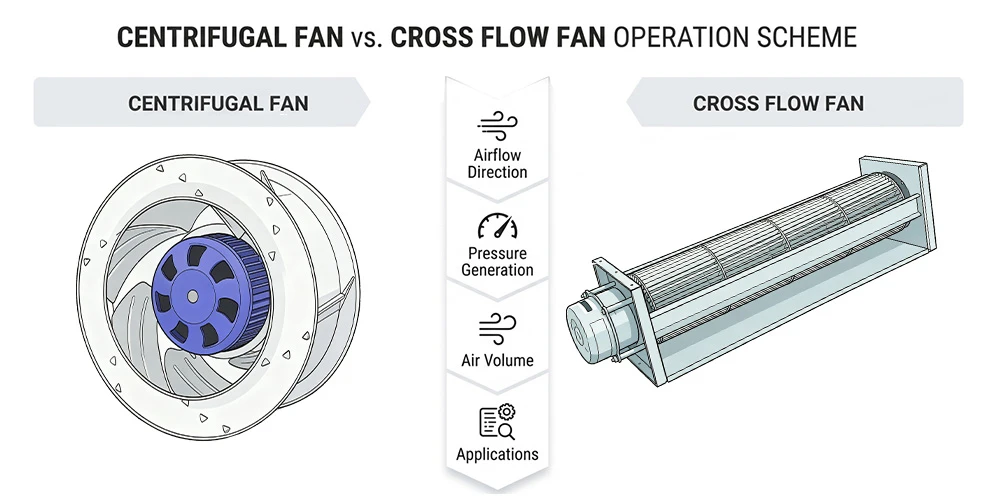
A centrifugal fan operates on the principle of converting kinetic energy into potential energy. This type of fan uses a rotating impeller to accelerate air radially, increasing the air pressure as it moves through the fan housing. Once air is sucked into the center, the blades propel it outward at a 90-degree angle to the axis, where it is pushed through an outlet duct.
Key Features of Centrifugal Fans:
Radial Air Movement: Air moves at a right angle to the fan's intake, which helps in generating high-pressure airflow.
High Efficiency at Low Flow Rates: Centrifugal fans are ideal when high pressure and low flow rates are required.
Heavy-Duty Design: These fans are built to handle more challenging conditions, including moving air containing particulates.
Variety of Impeller Designs: Centrifugal fans come in various configurations like backward-curved, forward-curved, and radial designs, each suited to different types of applications.
Applications of Centrifugal Fans:
Centrifugal fans are used across various sectors due to their high-pressure output and adaptability to different environments. They are commonly found in:
HVAC Systems: Ideal for moving air through ducts and ventilation systems.
Industrial Ventilation: Used in factories and workshops to move contaminated air or fumes.
Cooling Systems: Deployed in equipment and machinery that require consistent cooling under high pressure.
Dust Collection: Centrifugal fans are integral to dust collection systems where air mixed with particles needs to be moved.
What is a Cross Flow Fan?
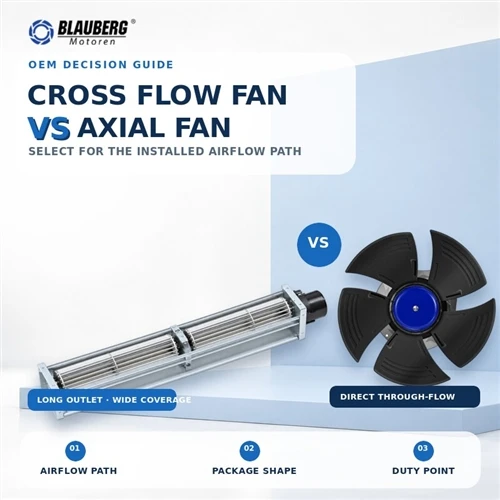
A cross flow fan, also known as a tangential or transverse fan, operates by drawing air perpendicularly across the fan's axis. The airflow enters the impeller at one side and exits the opposite side in a continuous flow. Unlike centrifugal fans, cross flow fans are designed to move large amounts of air with less pressure but at a steady rate. Their compact shape allows them to be used in systems where space is limited.
Key Features of Cross Flow Fans:
Perpendicular Airflow: Air enters and exits at right angles, providing uniform airflow across the fan's length.
Laminar Flow: This design ensures a smooth and consistent airflow, ideal for applications where even air distribution is needed.
Low Noise Operation: Cross flow fans operate quietly, making them suitable for noise-sensitive environments.
Compact Design: Their cylindrical shape makes them ideal for use in smaller systems where other types of fans would not fit.
Applications of Cross Flow Fans:
Cross flow fans are commonly used in applications where space is a constraint, and a gentle, even airflow is needed. Some typical applications include:
Electronics Cooling: Used in devices like projectors, PCs, and other electronic devices where space is limited.
Air Curtains: Employed in air curtain systems that prevent the exchange of air between indoor and outdoor environments.
Home Appliances: Found in appliances like ovens, microwaves, and air conditioners where uniform airflow is essential.
Cooling in Enclosures: Used in compact systems like fireplace inserts and heat recovery ventilators.
Centrifugal Fans vs Cross Flow Fans: Operational Differences
Airflow Direction and Mechanism
Centrifugal Fans: The key feature of centrifugal fans is their radial air movement. Air is drawn into the fan parallel to the axis but expelled perpendicularly, resulting in a 90-degree redirection of airflow. This makes centrifugal fans suitable for applications requiring high-pressure airflow in constrained duct systems.
Cross Flow Fans: Cross flow fans generate airflow perpendicular to the axis and allow the air to pass through the fan twice. This unique design helps produce a laminar, smooth airflow. Cross flow fans are more suited for applications that require uniform and even air distribution rather than high pressure.
Pressure and Airflow Characteristics
Centrifugal Fans: Designed for high-pressure environments, centrifugal fans excel at moving air or gases under pressure. This makes them ideal for applications requiring strong airflow against resistance, such as in ductwork or industrial systems.
Cross Flow Fans: In contrast, cross flow fans operate at much lower pressures. Their focus is on moving large amounts of air over broad surfaces rather than generating high pressure. This makes them well-suited for systems like air curtains, where even airflow is critical but pressure is not.
Energy Efficiency
Centrifugal Fans: Centrifugal fans tend to consume more power, especially when high-pressure airflow is needed. However, they are more efficient when operating under load, especially in systems requiring air to move through filters or other resistances.
Cross Flow Fans: Cross flow fans are more energy-efficient in low-pressure applications. Their simple design allows for effective air movement in compact systems with minimal energy consumption. They are ideal for applications requiring steady, continuous airflow at low pressures.
Noise Levels
Centrifugal Fans: Due to the nature of their operation and high-pressure capabilities, centrifugal fans tend to be noisier. The noise levels increase as the fan handles higher pressures and speeds, making them less suitable for environments where quiet operation is needed.
Cross Flow Fans: These fans operate much more quietly than centrifugal fans, especially at lower speeds. This makes them ideal for residential and office settings or any application where noise reduction is a priority.
Space Requirements
Centrifugal Fans: Generally, centrifugal fans require more space to operate effectively, particularly in high-performance applications that need larger impellers and housing. This can be a limitation in compact or space-constrained environments.
Cross Flow Fans: Their compact, cylindrical design makes cross flow fans perfect for installations where space is at a premium. They are used in narrow enclosures where other fan types may not fit.

Choosing Between Centrifugal Fans and Cross Flow Fans
When to Choose Centrifugal Fans:
High-Pressure Requirements: If the application requires moving air against resistance, such as in duct systems, filters, or fume extraction, centrifugal fans are the better choice due to their high-pressure output.
Industrial Use: For heavy-duty industrial environments where air must be moved through complicated duct systems or where particulates are present in the air, centrifugal fans excel.
HVAC Systems: In large-scale HVAC systems, centrifugal fans provide the necessary pressure to ensure consistent airflow across long distances and through various obstructions.
When to Choose Cross Flow Fans:
Compact Applications: Cross flow fans are ideal for applications where space is limited, such as in electronic cooling or small appliances.
Uniform Air Distribution: If your system requires even, laminar airflow across a wide surface, such as in air curtains or electronics cooling systems, cross flow fans are the optimal choice.
Low-Noise Environments: For settings where noise reduction is important, such as in residential or office environments, cross flow fans are better suited due to their quieter operation.
Conclusion: Centrifugal Fans vs Cross Flow Fans
Both centrifugal fans and cross flow fans serve essential roles in air movement systems, but their operational principles and applications differ significantly. Centrifugal fans are designed for high-pressure, industrial applications where airflow must overcome resistance, while cross flow fans excel in low-pressure, compact systems where even airflow and quiet operation are essential.
Understanding these differences will help you choose the best fan for your specific application, whether it's for industrial use, home appliances, or electronic cooling systems. By selecting the right fan type, you can ensure optimal performance, energy efficiency, and noise control for your system.