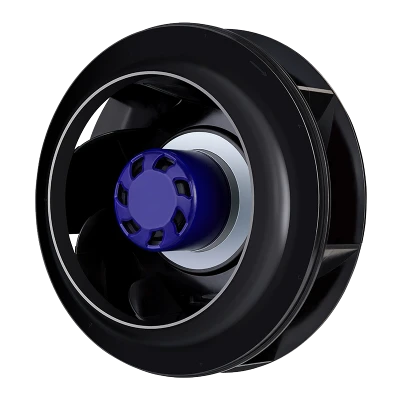
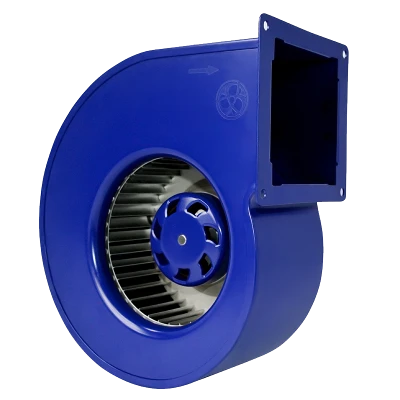
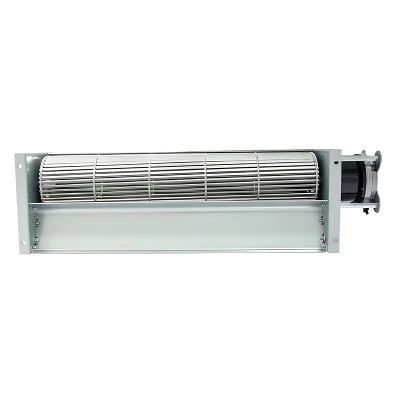
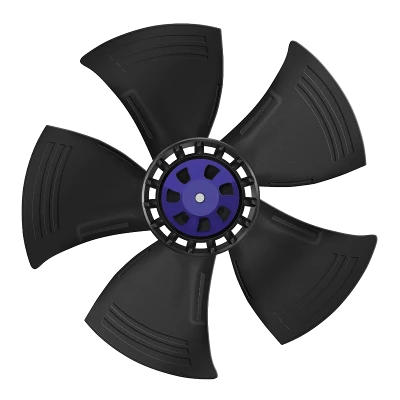
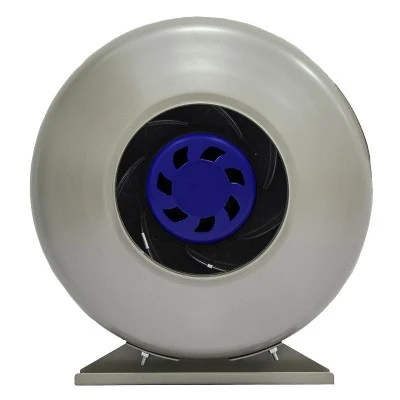
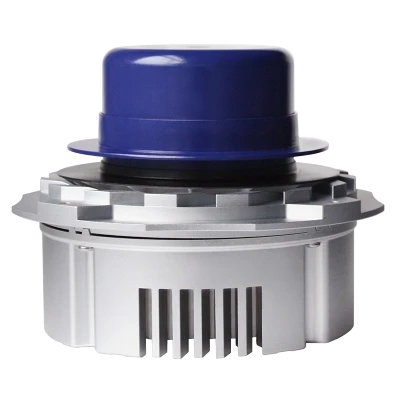
When it comes to modern ventilation, cooling and HVAC systems, the backward fan - more accurately called the backward curved centrifugal fan - is one of the most popular and efficient fan types used across industrial and commercial environments. But what exactly does "backward fan" mean, and how does this type of fan work?
In this article, we will explain what a backward fan is, how it operates, and why it is widely chosen for demanding airflow applications.
What Is a Backward Fan?
A backward fan refers to a specific style of centrifugal fan that uses blades curved opposite (backward) to the direction of rotation. Because of this "backward-curved" blade design, airflow travels smoothly across the blade surface, resulting in higher static pressure, lower noise, and greater energy efficiency compared to traditional forward-curved centrifugal fans.
How Does a Backward Fan Work?
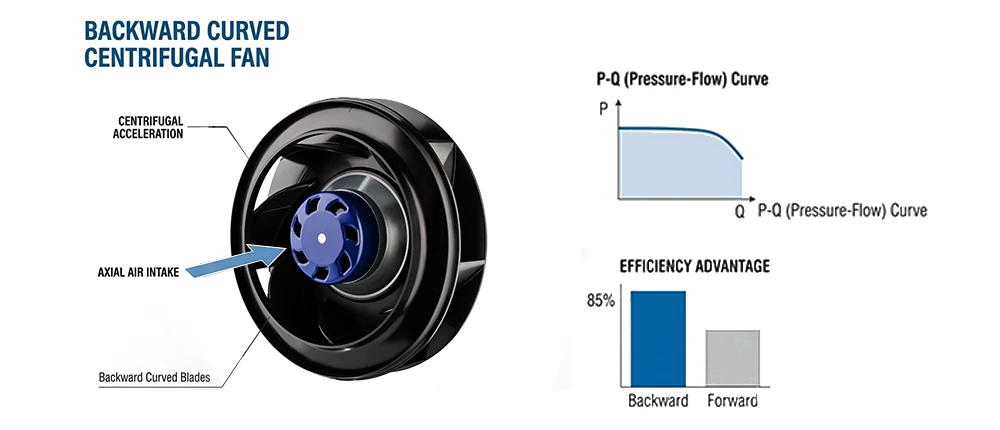
Backward fans draw air into the center of the impeller and then expel it radially (outwards) under centrifugal force. The backward-curved blades guide the airflow at an angle which reduces turbulence and allows for more efficient pressure conversion.
Working process:
Air intake → through the centre (axial direction)
Impeller rotation → accelerates air radially outward
Outlet air → discharged into a spiral shaped housing (volute), where high-velocity airflow is converted into pressure.
Design Features of Backward Fans
| Feature | Description |
|---|---|
| Blade Curvature | Curved backward, opposite to the direction of rotation |
| Blade Shape | Often airfoil or smooth curved blade profile |
| Efficiency | Typically 10–20% higher than forward curved designs |
| Noise Level | Lower turbulence = quieter operation |
| Pressure Capability | Medium to high static pressure |
| Stability | Flat performance curve → stable under varying system resistance |
Advantages of Backward Fans
High Efficiency
Backward blades reduce air separation and recirculation, allowing the fan to convert motor power into airflow more efficiently.
Lower Energy Consumption
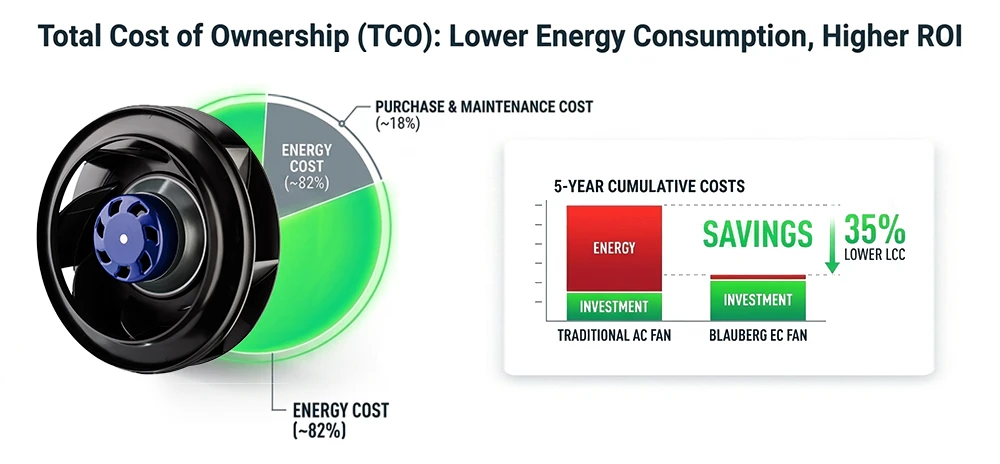
Ideal for long-running systems (24/7 operation) where energy savings translate into significant cost reductions.
Low Noise Output
Smooth airflow over backward curved blades leads to quieter operation – perfect for noise-sensitive environments.
Strong Static Pressure
Backward fans can overcome higher duct resistance, making them suitable for systems with long or complex ventilation pipelines.
Reliable & Stable
They provide consistent airflow even if operating resistance changes in the system (e.g., filter loading).
Common Applications of Backward Curved Fans
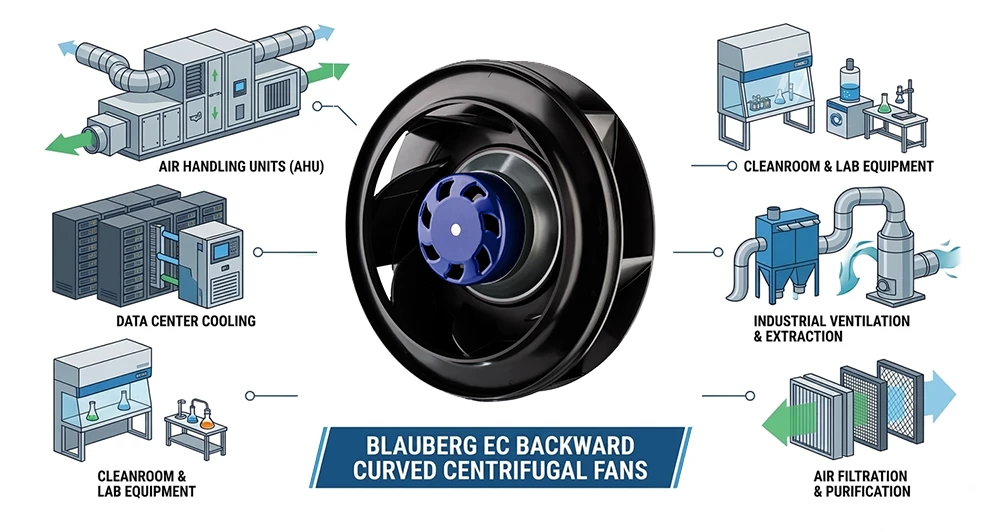
Backward fans are used in places where a combination of high pressure, efficient airflow, and low noise are required:
Air handling units (AHU)
Industrial ventilation and extraction
Cleanrooms and lab equipment
Air filtration and purification systems
At Blauberg-motoren, our backward curved centrifugal fans (such as 280 mm, 355 mm, and 400 mm EC/AC models) are widely used in high-end air conditioning and ventilation projects globally. All units meet UL, CE, ROHS, CCC and ISO requirements and support customizable specifications.
Backward Fan vs Forward Fan – What's the Difference?
| Backward Fan | Forward Fan | |
|---|---|---|
| Blade Direction | Curved backward | Curved forward |
| Efficiency | Higher | Lower |
| Static Pressure | Medium to high | Low to medium |
| Noise Level | Low | Higher |
| Best Used In | Energy-efficient industrial ventilation | High-volume, low-pressure exhaust |
Conclusion
A backward fan (backward curved centrifugal fan) is a high-performance solution for systems requiring strong pressure, high efficiency, and lower noise. Its aerodynamic blade design makes it suitable for energy-conscious HVAC and ventilation applications, especially where long-term operational stability is critical.
Looking for reliable backward fans?
Contact Blauberg-motoren today to explore our full range of EC backward curved centrifugal fans and AC backward curved centrifugal fans for ventilation, filtration, refrigeration, and more.