Introduction
When selecting a centrifugal fan for HVAC systems, air handling units, data centers, or industrial ventilation equipment, one of the most common engineering questions is:
What is the difference between a forward and a backward centrifugal fan?
Although both belong to the centrifugal fan family and operate on the same fundamental principle, their blade design, efficiency, noise level, and ideal applications differ significantly.
Understanding these differences is critical for:
Ventilation & Purification
Cold Storage & Cold Chain
Mechanical Equipment
Energy-saving retrofit projects
From a professional airflow engineering perspective, this guide explains the technical distinctions and helps you determine the most suitable solution for your project.
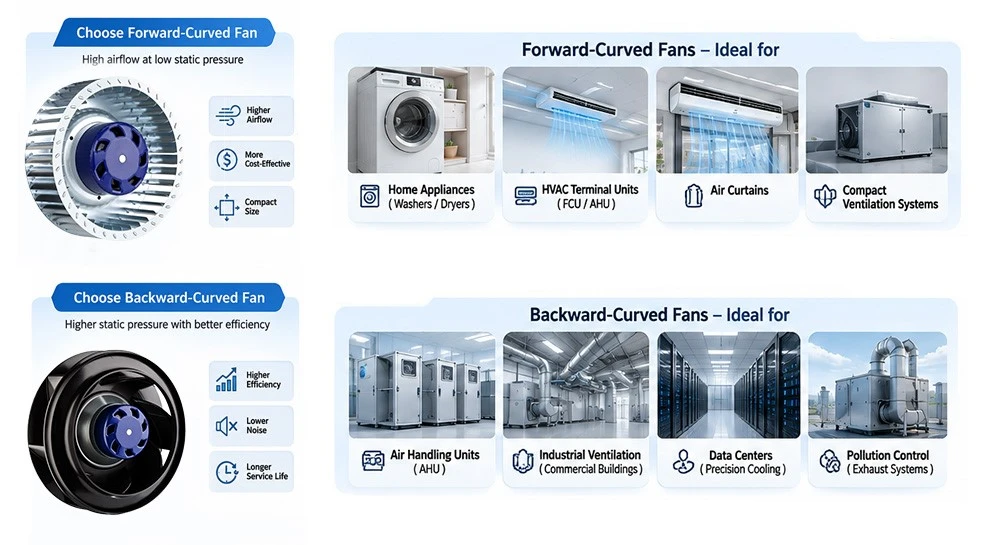
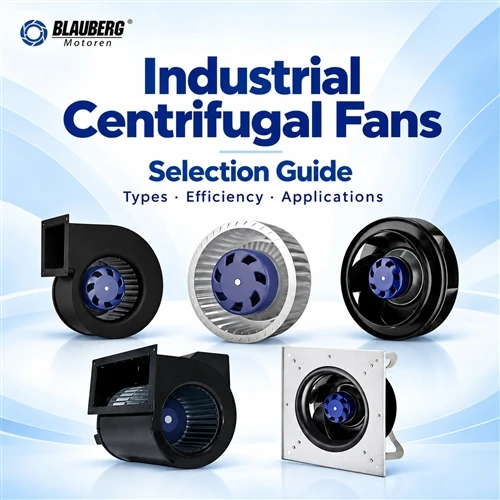
What Is a Forward Centrifugal Fan?
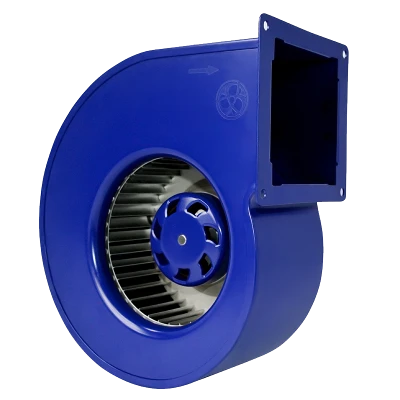
A forward centrifugal fan (also called a forward curved fan) features blades that curve in the same direction as the impeller rotation.
Structural Characteristics:
Multiple small curved blades
Scroll (volute) housing
Compact design
Lower rotational speed
Performance Features:
High airflow volume
Low to medium static pressure
Moderate efficiency
Higher noise at higher loads
Forward centrifugal fans are commonly used in:
Household Electric Appliances
Small HVAC indoor units
Air conditioning systems
Heating equipment
They are cost-effective and suitable for systems requiring high airflow at relatively low resistance.
What Is a Backward Centrifugal Fan?
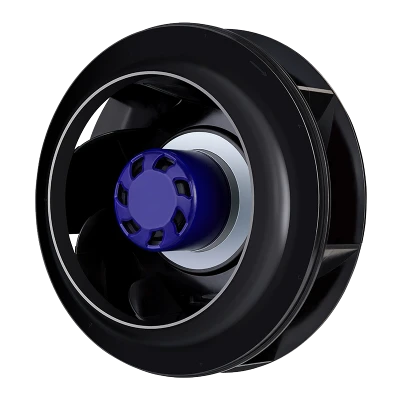
A backward centrifugal fan (backward curved or backward inclined) has blades that curve opposite the direction of rotation.
Structural Characteristics:
Fewer, wider blades
Aerodynamically optimized geometry
Often direct-driven
Can be scroll-type or plug-type
Performance Features:
Higher efficiency
Non-overloading power curve
Medium to high static pressure
Lower noise
Better energy performance
Backward centrifugal fans are widely used in:
Air Handling Units (AHU)
Cloud Data Centers
Medical ventilation systems
Ventilation & Purification systems
They are considered the preferred solution for modern energy-efficient systems.

Core Differences Between Forward and Backward Centrifugal Fans
| Feature | Forward Centrifugal Fan | Backward Centrifugal Fan |
|---|---|---|
| Blade Direction | Curved forward | Curved backward |
| Efficiency | Moderate | High |
| Static Pressure | Low to Medium | Medium to High |
| Noise Level | Higher at high load | Lower |
| Power Curve | May overload | Non-overloading |
| Energy Saving | Limited | Excellent |
| Typical Applications | Small HVAC / appliances | Commercial HVAC / data centers |
Efficiency and Energy Performance
From an energy engineering standpoint:
Backward centrifugal fans deliver higher total efficiency because:
Airflow exits the impeller more smoothly
Reduced turbulence
Lower mechanical loss
Optimized aerodynamic blade angle
When combined with EC motors, backward centrifugal fans achieve superior performance, making them ideal for:
Energy-saving & Intelligent Retrofitting
Large-scale HVAC systems
Continuous-operation environments
Forward fans, while compact and economical, generally cannot match the energy performance of backward designs.
Noise Comparison
Noise is a critical parameter in:
Medical Industry
Commercial buildings
Data centers
Backward centrifugal fans typically produce lower noise due to:
Reduced turbulence
Optimized blade geometry
Lower rotational speed for equivalent performance
At Blauberg-motoren, all centrifugal fans are tested in our Noise Lab with 16dBA background noise, ensuring reliable acoustic performance validation.
Static Pressure Capability
If your system includes:
Long ductwork
Air filtration resistance
Heat exchangers
High-resistance components
Backward centrifugal fans are usually the better option due to stronger static pressure capability.
Forward fans are more suitable for:
Low-resistance airflow systems
Compact air conditioning units
When Should You Choose a Forward Centrifugal Fan?
Forward fans are recommended when:
Space is limited
Budget sensitivity is high
Static pressure requirement is low
Application is small-scale HVAC
Typical examples:
Fan coil units
Compact heating systems
Household appliances

When Should You Choose a Backward Centrifugal Fan?
Backward fans are recommended when:
Energy efficiency is critical
Static pressure is medium to high
System operates continuously
Noise reduction is important
Long-term operational cost matters
Typical industries include:
Cloud Data Centers
Air Conditioning Systems
Cold Storage & Cold Chain
Medical Ventilation
Ventilation & Purification Systems
Mechanical Equipment
The Role of EC Technology
Modern HVAC systems increasingly adopt:
EC Backward Centrifugal Fans
EC Plug Fans
Intelligent airflow control systems
EC motors offer:
Higher motor efficiency
Speed modulation
Lower power consumption
Intelligent building integration
In energy-conscious markets, EC backward centrifugal fans are becoming the mainstream solution.
Engineering Validation and Testing
Fan performance depends on precise design and laboratory verification.
At Blauberg-motoren, our R&D department includes:
Fluid Lab with multi-size airflow test equipment
Noise Lab (16dBA background)
Electronic Lab for motor software testing
Shaking test equipment
Salt spray testing
High/Low temperature testing chambers
Dynamometer systems
Our multidisciplinary team of software engineers, mechanical engineers, and customization designers ensures that both forward and backward centrifugal fans deliver stable, verified performance under real-world conditions.
Final Recommendation
There is no universal "better" option - only the right solution for your application.
For compact, low-pressure systems → Forward centrifugal fans are practical and cost-effective.
For high-efficiency, medium-to-high pressure, and energy-saving systems → Backward centrifugal fans are generally superior.
In modern commercial and industrial HVAC systems, backward centrifugal fans - especially EC types - are typically the preferred choice due to efficiency, reliability, and long-term cost advantages.
Need Help Selecting the Right Centrifugal Fan?
Choosing between forward and backward centrifugal fans requires analyzing:
Airflow (CFM / m³/h)
Static pressure (Pa)
Noise limits
Operating hours
Installation constraints
Energy-saving targets
Our engineering team provides:
Technical consultation
Customized airflow solutions
OEM / ODM manufacturing
Application-specific product recommendations
If you are designing an HVAC system, upgrading ventilation equipment, or planning a data center cooling project, contact us today for professional selection support tailored to your requirements.